


Non-surgical treatment for localised fat with personalised intralipotherapy
Aqualyx® Hydrolipolysis is an injectable treatment designed to reduce small, selected areas of localised fat in patients who do not require or do not wish to undergo surgical liposuction.
Aqualyx® contains ingredients based on deoxycholate / sodium deoxycholate, which act within the fatty tissue and disrupt the membranes of fat cells in the treated area.
The body then gradually clears the cellular debris through its natural metabolic and inflammatory processes.
This treatment may be suitable for patients who:
- are relatively close to their ideal body weight,
- have persistent localised fat deposits,
- do not need large-volume fat removal,
- prefer a less invasive approach,
- have realistic expectations about the result.
Aqualyx® is not a weight-loss treatment and is not intended to treat obesity.
What is Hydrolipolysis?
Hydrolipolysis / Intralipotherapy is an injectable technique in which a specialised fat-reducing product is placed directly into the subcutaneous fatty tissue.
The deoxycholate component acts on fat-cell membranes, leading to their disruption.
The body then gradually removes the resulting cellular debris.
For this reason, the final change is not fully visible on the day of treatment. The result develops progressively over the following weeks.
What is Aqualyx®?
Aqualyx® is an injectable product used in Europe for the treatment of selected localised fat deposits through intralipotherapy.
Its formulation includes sodium deoxycholate in a specialised aqueous system.
Its purpose is localised fat reduction, not overall body-weight loss. Correct patient selection and appropriate treatment-area selection are therefore essential.
How does Aqualyx® work?
Deoxycholate acts as a surfactant within fatty tissue.
When placed at the appropriate anatomical depth, it can disrupt fat-cell membranes.
This is followed by a local inflammatory response and gradual clearance of the cellular debris by the body.
The process is more accurately described as adipocytolysis rather than simply “burning fat”.
Which areas can be treated?
Depending on the anatomy and indication, Aqualyx® may be considered for small to moderate localised fat deposits in areas such as:
- double chin,
- upper arms,
- abdomen,
- waist / love handles,
- hips,
- outer-thigh fat pockets,
- areas around or above the knees,
- inner thighs,
- outer thighs,
- back,
- selected chest fat deposits.
Suitability for each area is determined after medical assessment.
Aqualyx® for a Double Chin
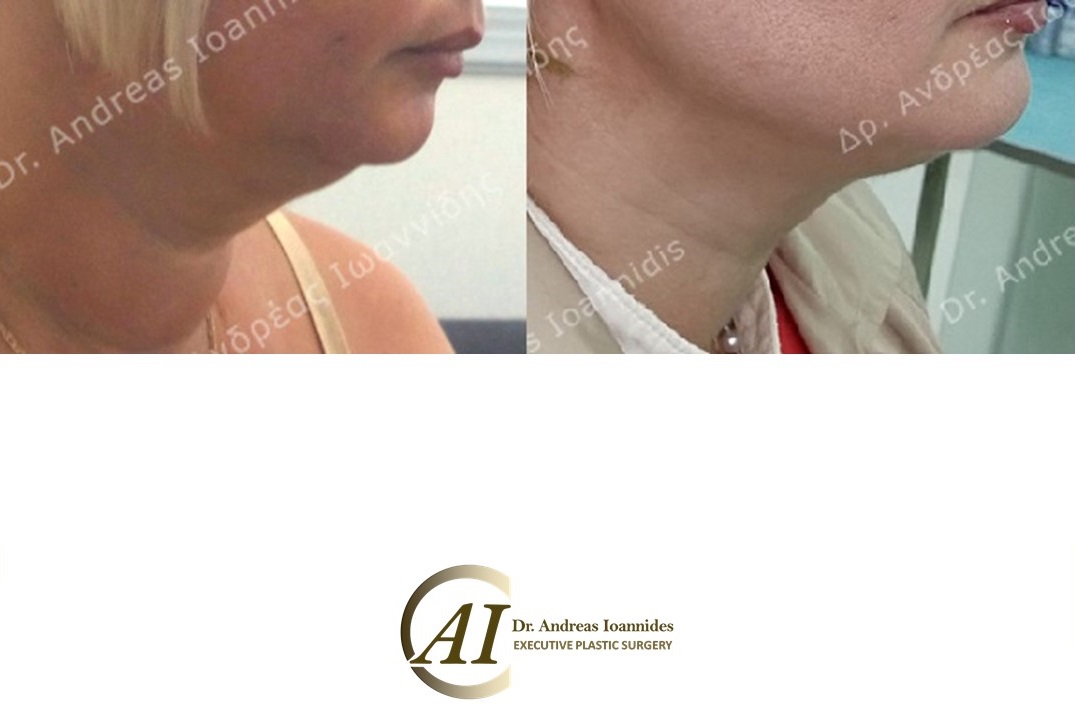
The double chin is one of the areas where injectable fat reduction may be useful in appropriately selected patients.
The problem may be caused by:
- localised fat,
- skin laxity,
- a small or recessed chin,
- jaw anatomy,
- a combination of factors.
For this reason, not every double chin requires the same treatment.
If the main problem is skin laxity rather than fat, a better option may be:
- ThermiTight™,
- liposuction,
- chin contouring,
- genioplasty,
- or a combined approach.
Aqualyx® for the Abdomen and Waist
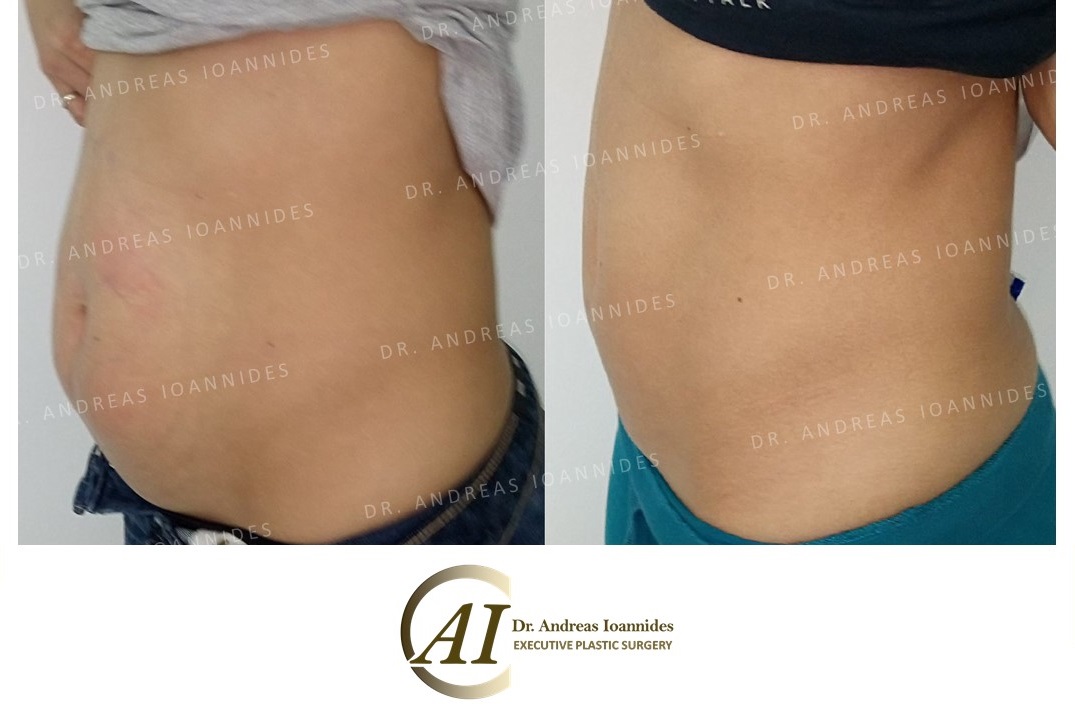
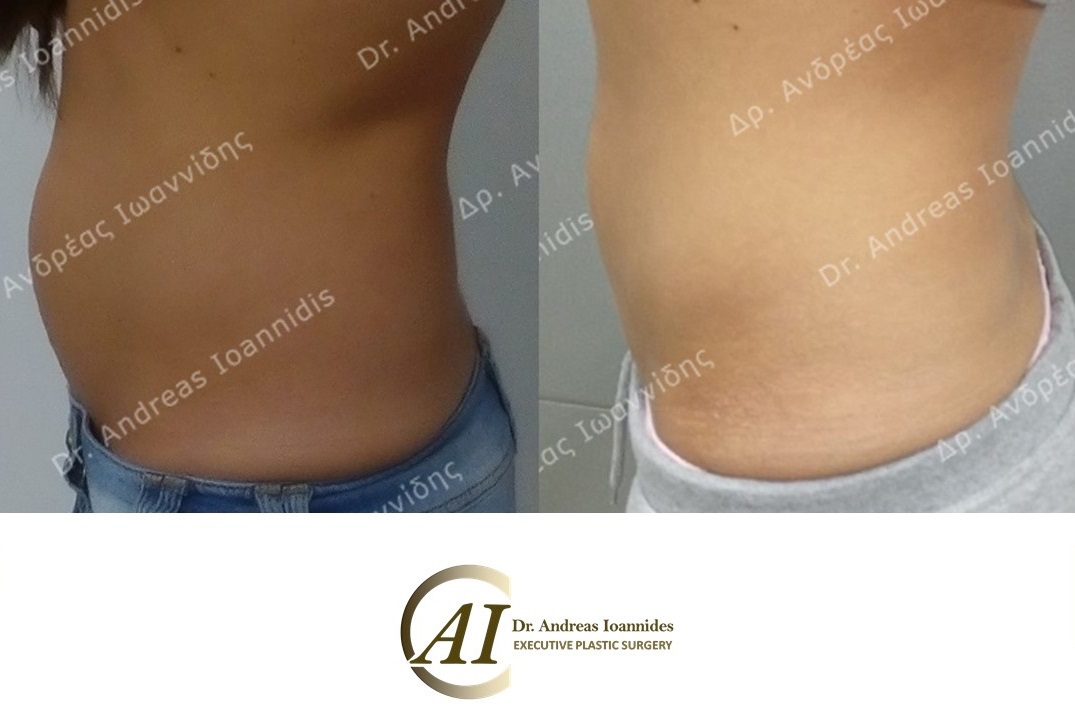
Small localised fat deposits around the abdomen or waist may be treated with intralipotherapy in selected patients.
The treatment may be more appropriate when:
- the amount of fat is limited,
- body weight is relatively stable,
- the skin has good elasticity,
- there is no significant excess skin.
When a larger amount of fat is present, liposuction may provide a more effective and predictable result.
Aqualyx® for Arms, Thighs and Knees
For small fat deposits in the:
- upper arms,
- inner thighs,
- outer thighs,
- knee area.
Aqualyx® may be used to improve local contour.
However, it does not correct significant skin laxity.
When both fat and loose skin are present, an alternative or additional skin-tightening treatment may be required.
Is Aqualyx® the same as liposuction without surgery?
Not exactly.
Liposuction physically removes fatty tissue during a surgical procedure.
Aqualyx® gradually destroys fat cells in smaller, selected treatment areas.
Aqualyx®
May be suitable when there is:
- a small or moderate localised fat deposit,
- a need for limited correction,
- a preference for a non-surgical approach.
Liposuction
May be more appropriate when there is:
- a larger volume of fat,
- a need for more substantial contouring,
- multiple treatment areas,
- a desire for more immediate and controlled shaping.
The choice is made individually.
Aqualyx® or ThermiTight™?
The two treatments have different primary goals.
Aqualyx®
Focuses mainly on localised fat reduction.
ThermiTight™
Focuses more on:
- tissue tightening,
- improvement of laxity,
- and, in selected cases, additional fat reduction.
When both localised fat and skin laxity are present, Dr Andreas Ioannides may recommend a different or combined treatment approach.
Aqualyx® or Laser Lipolysis?
Laser Lipolysis and Aqualyx® are not the same treatment.
Laser Lipolysis uses energy-based technology and may offer more control in reshaping fatty tissue.
Aqualyx® is an injectable treatment.
The most appropriate choice depends on:
- the amount of fat,
- the area,
- skin quality,
- degree of laxity,
- the desired result.
How many sessions are required?
There is no single number of sessions that applies to everyone.
Many intralipotherapy protocols involve more than one session, with several weeks between treatments so the tissues can respond and the result can be properly assessed.
The number of treatments depends on:
- the size of the fat deposit,
- the treatment area,
- individual response,
- the desired degree of correction.
In some patients, approximately 2–4 sessions may be considered, but the actual plan is always personalised.
How often can the treatment be repeated?
The body needs time to complete the local inflammatory and metabolic response after treatment.
For this reason, sessions should not be repeated too close together. It is suggested to repeat the therapy every 20–30 days.
The appropriate interval is determined by the doctor according to:
- the product,
- the treatment area,
- the tissue response,
- the treatment protocol.
When will I see the results?
The result is not immediate in the same way as liposuction.
Time is required for:
- the local tissue response,
- swelling to settle,
- the gradual clearance of disrupted fat cells.
A meaningful assessment is usually made several weeks after treatment.
The result may continue to develop after each session.
What should I expect after Aqualyx®?
After treatment, it is common to experience:
- swelling,
- redness,
- tenderness,
- bruising,
- a burning or tight sensation,
- temporary firmness or small nodules in the area.
These local reactions usually settle gradually.
Is there downtime?
Recovery is generally more limited than with surgical liposuction.
However, visible swelling may last for several days.
Depending on the treatment area and the intensity of the response, most patients can return relatively quickly to daily activities.
Social downtime may be more noticeable when treating the double chin because swelling is visible.
Is the treatment painful?
During and after treatment, patients may experience:
- stinging,
- burning,
- pressure,
- tenderness.
The intensity varies between patients and treatment areas.
Appropriate comfort measures and, where needed, local anaesthetic techniques may be used.
What should I avoid after treatment?
Patients receive specific aftercare instructions.
Depending on the area, they may be advised to:
- avoid strenuous exercise temporarily,
- avoid excessive heat,
- stay well hydrated,
- avoid strong pressure or unapproved massage,
- use cold compresses when appropriate,
- take pain relief only as directed by the doctor.
Patients should not perform aggressive massage or use treatment devices on the area without medical guidance.
Can Aqualyx® be combined with lymphatic massage or other treatments?
In selected cases, complementary care may be considered after the initial reaction has settled.
This may include, where appropriate:
- gentle lymphatic support,
- body-contouring treatments,
- RF,
- other techniques depending on the treatment goal.
There is no benefit in automatically combining every treatment for every patient.
The combination is selected individually.
Is Aqualyx® safe?
Intralipotherapy is a medical injectable procedure and is not risk-free.
Most side effects are local and temporary.
They may include:
- significant swelling,
- pain,
- bruising,
- temporary nodules,
- changes in sensation,
- inflammation,
- infection,
- contour irregularity.
Less commonly, more serious complications such as skin injury or necrosis have been reported, particularly when the product is placed at an inappropriate anatomical level or when injection technique is incorrect.
For this reason, treatment should be performed by an appropriately trained physician.
Who may not be suitable for treatment?
Final suitability is always determined after medical history and examination.
Treatment may not be appropriate in situations such as:
- pregnancy,
- breastfeeding,
- active infection in the treatment area,
- certain serious chronic illnesses,
- liver disorders or significant metabolic disease,
- selected immune or inflammatory conditions,
- known hypersensitivity to product components,
- unrealistic expectations.
Having a chronic medical condition does not automatically mean treatment is impossible; individual medical assessment is required.
Is Aqualyx® suitable for obesity?
No.
Aqualyx® is not a treatment for:
- obesity,
- generalised body fat,
- weight loss.
It is intended for localised fat deposits.
The best candidate is usually someone with relatively stable body weight and small stubborn areas of fat that persist despite diet and exercise.
Is the result permanent?
The fat cells that are destroyed do not simply return in the same form.
However, remaining fat cells can increase in size if the patient gains significant weight.
Maintaining:
- stable body weight,
- a balanced diet,
- regular exercise,
helps support long-term results.
Why choose Aqualyx® with Dr Andreas Ioannides?
Injectable fat reduction is not simply a matter of injecting a product.
Correct treatment requires knowledge of:
- subcutaneous fat thickness,
- anatomy,
- vascular and nerve distribution,
- the correct injection depth,
- the amount that can be treated safely,
- the limitations of the technique.
Dr Andreas Ioannides, Plastic, Aesthetic & Reconstructive Surgeon, can also assess whether Aqualyx® is genuinely the best option or whether a better result may be achieved with:
- liposuction,
- Laser Lipolysis,
- ThermiTight™,
- FRBR + Argon,
- or a combined approach.
We do not choose the treatment first and fit the patient to it. We choose the treatment that best suits your anatomy.
How much does Aqualyx® cost?
The cost of Aqualyx® Hydrolipolysis varies according to the individual case.
The final price depends on:
- the treatment area,
- the size of the fat deposit,
- the amount of product required,
- the number of sessions,
- whether multiple areas are treated,
- any combination treatments.
For this reason, the exact price is determined after a personal consultation.
Small localised fat does not always mean surgery
For a patient with a small localised fat deposit, surgical liposuction is not always the only option.
Aqualyx® Hydrolipolysis may be considered when:
- the treatment area is small,
- the skin quality is good,
- large-volume fat removal is not required,
- the patient prefers an injectable approach.
The important point is to select the correct treatment for the actual problem.
Would you like to know if Aqualyx® is right for you?
During your personal consultation, Dr Andreas Ioannides will assess:
- the amount of localised fat,
- skin quality,
- the presence of laxity,
- body weight,
- the treatment area,
- medical history,
- your desired result.
The most appropriate option can then be selected Aqualyx®, liposuction, Laser Lipolysis, ThermiTight™, FRBR + Argon or a combination of techniques.
Frequently Asked Questions About Aqualyx®
Aqualyx® is an injectable product used in intralipotherapy techniques to reduce selected localised fat deposits.
Deoxycholate disrupts fat-cell membranes, and the body then gradually clears the resulting cellular debris.
No. It is used for localised fat, not for overall weight reduction.
Selected fat deposits such as the double chin, abdomen, waist, arms, thighs and knees may be treated depending on the indication.
The number is individualised. In many cases, approximately 2–4 sessions may be considered.
Sessions are usually spaced several weeks apart so the tissue response can be properly assessed.
The change develops gradually and is assessed several weeks after treatment.
Yes. Swelling, redness, bruising and tenderness are common temporary reactions.
Neither treatment is universally “better”. Aqualyx® is more suitable for smaller localised deposits, while liposuction offers greater fat-removal and contouring capacity.
The treated fat cells are destroyed, which may provide long-term improvement. However, future weight gain can affect the result.
It is a medical injectable treatment with potential risks and should be performed by an appropriately trained physician.
The price depends on the treatment area, amount of product and number of sessions. The exact cost is determined after a personal consultation.
CONTACT

Dr. Andreas Ioannides
Contact us and book an appointment immediately
Choose your appointment by video call or by visiting one of our clinics!

Dr. Andreas Ioannides Executive Plastic Surgery is one of the most complete plastic surgery clinics and the international medical aesthetic medical centers ADVANCED AESTHETICS provide modern medical techniques and aesthetic medical treatments in Greece and Cyprus.
September and Plastic Surgery: Why Autumn Can Be a Good Time to Plan an Aesthetic Procedure
September and Aesthetic Treatments: Why It’s the Ideal Time for a Fresh Start
Thinking About Labiaplasty? 10 Things You Should Know Before Moving Forward
Labiaplasty: Everything You Need to Know About the Procedure That Improves Comfort and Confidence
Medical Tourism in Greece and Cyprus: Choosing Quality, Experience, and Safety
Rhinoplasty: Everything You Need to Know
Body Firming & Contouring – Advanced Aesthetics by Dr. Andreas Ioannides
Athens Clinic
T +30.210 9595566
Email: info@andreasioannides.com
Address: Syggrou Ave, 284, Kallithea, Zip 17673 – Athens
Cyprus Clinics
T +357.22335002
Email: info@andreasioannides.com
Athenium International Medical Institute
Address: Giannitson 9 Strovolos, Nicosia 2027, Cyprus
Address: Thiseos 1, Lemesos 3025, Zip 4004 – Cyprus
Copyright © 2022