


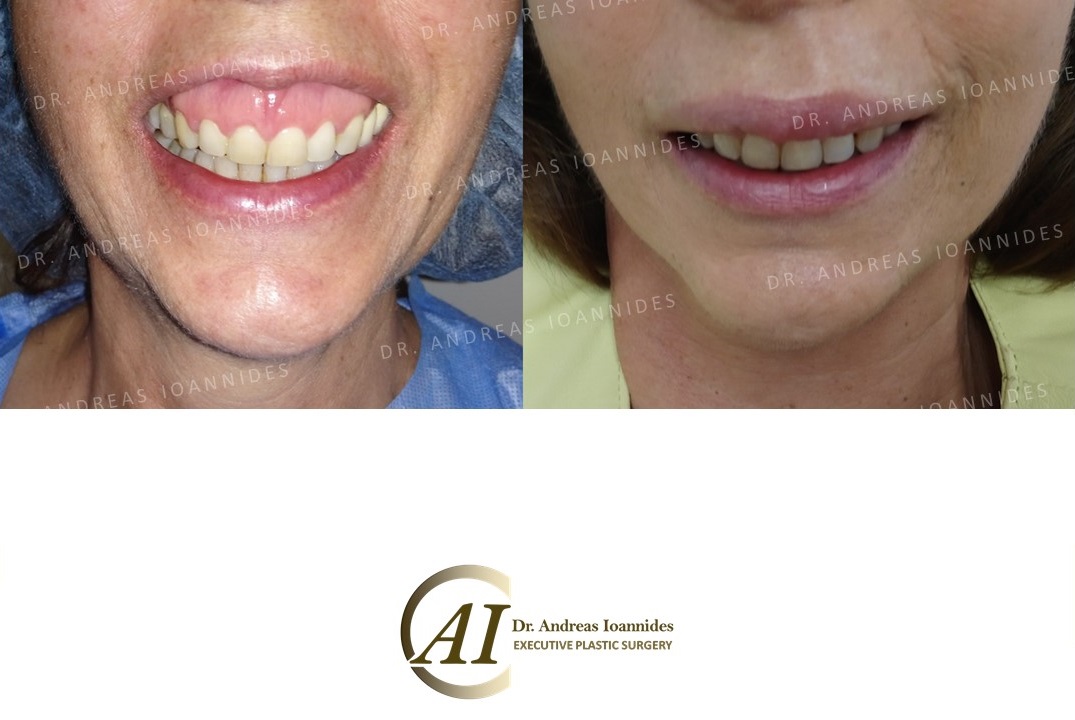
A more balanced smile with personalised treatment of the gums, upper lip and muscle activity
A gummy smile refers to excessive gum exposure when smiling or laughing.
For some people, this becomes especially noticeable in photographs or during a full smile and may affect the overall harmony between:
- the upper lip,
- teeth,
- gums,
- nose,
- midface,
- lower jaw and chin.
A gummy smile does not always have a single cause.
It may be related to the position and mobility of the upper lip, the amount of visible gum, the anatomy of the upper jaw, the length of the upper lip or a combination of several factors.
For this reason, the correct treatment begins with anatomical assessment rather than a predetermined procedure.
What is a gummy smile?
A gummy smile occurs when a larger-than-desired amount of gum tissue is visible during smiling.
It may be associated with:
- excessive elevation of the upper lip,
- a short upper lip,
- hyperactivity of the muscles that elevate the upper lip,
- increased exposure of the upper teeth,
- a thick or hypertrophic upper lip,
- pronounced nasolabial folds,
- jaw or dental proportions that affect the smile.
In some patients, other facial or functional concerns may also be present, such as rhinoplasty-related issues, micrognathia, retrognathia or nasal breathing problems.
What causes a gummy smile?
Excessive gum exposure may result from one or more factors, including:
- overactivity of the upper-lip elevator muscles,
- a short upper lip,
- excessive or hypertrophic gum tissue,
- reduced visible tooth height because of gum coverage,
- increased vertical development of the upper jaw,
- anatomical disproportion of the midface,
- a combination of these factors.
Correct diagnosis is essential because treatment varies significantly depending on the cause.
Who is a suitable candidate for treatment?
Gummy smile treatment may be appropriate for women and men who:
- show excessive gum tissue when smiling,
- feel that the upper lip rises too high,
- have a short upper lip,
- have excessive gum coverage,
- want a more balanced relationship between lips, teeth and gums,
- want a more natural and harmonious smile,
- have realistic expectations from treatment.
How is a gummy smile treated?
There is no single treatment that is right for everyone.
The most appropriate option depends on the underlying anatomical cause.
Treatment may include:
- Botox,
- filler or fat transfer,
- upper-lip repositioning,
- gum contouring / gingivectomy,
- frenulum correction,
- surgical lip reshaping,
- orthognathic or maxillofacial treatment in selected cases,
- a combination of techniques.
Botox for gummy smile
In patients where the main problem is overactivity of the muscles that elevate the upper lip, Botox may be a useful non-surgical option.
Botulinum toxin temporarily reduces the activity of selected muscles so that the upper lip does not rise as much during smiling.
The aim is:
- reduced gum exposure,
- a more balanced smile,
- gentler upper-lip movement,
- preservation of natural facial expression.
The injections are placed at specific anatomical points according to each patient’s muscle pattern.
How long does Botox for gummy smile last?
The effect of Botox is temporary.
Duration varies from patient to patient and treatment usually needs to be repeated once muscle activity gradually returns.
It should not be considered a permanent solution.
For patients who want to try a less invasive approach before considering surgery, it can be a useful option.
Upper-lip filler for gummy smile
In selected patients, hyaluronic acid filler may be used to improve:
- support or apparent length of the upper lip,
- lip contour,
- partial coverage of the upper teeth and gums during smiling.
It is not suitable for every type of gummy smile.
Excessive filler can make the upper lip appear heavy or unnatural, so treatment must be carefully planned.
Fat transfer to the upper lip
In selected cases, fat transfer may also be considered.
Fat may be used to:
- restore volume,
- improve lip shape,
- provide natural enhancement in specific areas.
This is not a first-line option for every gummy smile and is used only when it genuinely suits the patient’s anatomy
Surgical upper-lip repositioning
Lip repositioning surgery is a surgical technique designed to reduce excessive upward movement of the upper lip.
It may involve carefully repositioning tissues along the inner surface of the upper lip.
The aim is to reduce the vertical excursion of the lip during smiling and therefore decrease gum exposure.
This technique may be appropriate when excessive upper-lip mobility is a major contributor and the anatomy is suitable for surgical correction.
Gum contouring / Gingivectomy with Laser
In patients where excess gum tissue covers too much of the visible tooth surface, gum contouring or gingivectomy may be considered.
With an appropriate dental or periodontal approach, selected gum tissue may be removed to reveal more of the natural tooth surface.
Laser may be used in suitable cases depending on the indication and technique.
Correction of a short or restrictive frenulum
In some patients, a short or restrictive frenulum may affect upper-lip mobility.
When clinically indicated, treatment may include:
- frenectomy,
- frenuloplasty,
- lengthening or release of the frenulum.
This is only appropriate when the frenulum is genuinely contributing to the problem.
Lip reduction or reshaping
In less common cases where significant upper- or lower-lip hypertrophy is also present, surgical reshaping may be considered.
Incisions are planned to remain as discreet as possible within the inner surface of the lip.
The aim is:
- improved proportions,
- a more natural lip thickness,
- a more harmonious smile.
When is maxillofacial surgery required?
In some patients, gummy smile is mainly caused by skeletal anatomy, such as increased vertical development of the upper jaw.
In these cases, Botox or filler cannot correct the underlying cause.
Specialist orthognathic or maxillofacial assessment may be required.
For this reason, correct diagnosis always comes before treatment.
Can different techniques be combined?
Yes.
In many patients, gummy smile has more than one cause.
For example, there may be a combination of:
- upper-lip hypermobility,
- excessive gum tissue,
- a short upper lip,
- disproportion of the chin or jaw.
In these cases, the best solution may involve a combination of treatments.
The goal is not simply to treat the visible symptom, but to address the factors creating the appearance.
Gummy smile and rhinoplasty
In patients seeking rhinoplasty, evaluation of the smile can be important for overall facial harmony.
The nose, upper lip and upper jaw are closely related both anatomically and aesthetically.
In selected cases, gummy smile treatment may form part of a broader facial harmonisation plan.
Gummy smile and the chin
A small or recessed chin can affect lower-face balance and may visually exaggerate other facial proportions.
In patients with:
- microgenia,
- hypogenia,
- retrognathia,
genioplasty or other lower-jaw treatment may be discussed as part of the overall facial assessment.
Why choose Dr Andreas Ioannides?
A gummy smile is not simply “too much gum”.
The appearance of the smile depends on the relationship between:
- muscles,
- lips,
- gums,
- teeth,
- nose,
- upper jaw,
- lower jaw,
- chin.
Dr Andreas Ioannides, Plastic, Aesthetic & Reconstructive Surgeon, assesses the smile within the broader context of facial anatomy.
Each treatment plan is designed according to:
- the true underlying cause,
- muscle activity,
- upper-lip length,
- the amount of gum exposure,
- jaw proportions,
- the patient’s goals.
The aim is not to restrict your smile. The aim is to make it more balanced and natural.
When will I see the results?
The timing depends on the treatment.
Botox
The effect develops gradually as the activity of the selected muscles decreases.
Filler
The change is visible immediately, although initial swelling takes time to settle.
Lip repositioning surgery
The result is assessed after swelling subsides and healing progresses.
Gum contouring
The change in visible tooth length can be noticeable relatively early, although the area requires time to heal fully.
How long do the results last?
Duration depends on the technique.
- Botox is temporary.
- Fillers are temporary.
- Fat transfer may provide a longer-lasting result, although some of the transferred fat may be reabsorbed.
- Surgical techniques may provide long-lasting anatomical correction, although natural ageing continues.
Are there risks?
Each treatment has its own potential risks.
Depending on the method, these may include:
- swelling,
- bruising,
- asymmetry,
- temporary changes in lip movement,
- infection,
- scarring,
- overcorrection or undercorrection,
- adverse effects associated with injectable materials.
Appropriate treatment selection and accurate anatomical technique are essential for both safety and a natural-looking result.
How much does gummy smile treatment cost?
The cost of gummy smile treatment varies depending on the underlying cause and the treatment required.
The final price may depend on:
- whether Botox is used,
- whether filler is required,
- the amount of injectable material,
- whether lip repositioning is needed,
- whether gum contouring is required,
- whether frenulum correction is necessary,
- whether multiple techniques are combined,
- anaesthesia and operating time for surgical procedures.
For this reason, the exact price is determined after a personal consultation.
The right smile is the one that suits your face
There is no single “ideal” smile for everyone.
Different people have different tooth proportions, lip volumes, gum height and patterns of muscle activity.
The success of treatment lies in balance.
Gummy Smile Treatment by Dr Andreas Ioannides
The aim is:
- less excessive gum exposure,
- natural lip movement,
- preservation of facial expression,
- improved harmony with the rest of the face.
A more harmonious smile — not a different smile.
Would you like to know which treatment is right for you?
During your personal consultation, Dr Andreas Ioannides will assess:
- the amount of gum exposure,
- upper-lip mobility,
- lip length and thickness,
- the teeth and gums,
- the frenulum,
- upper-jaw anatomy,
- the nose and chin,
- your desired result.
The most appropriate approach can then be selected:
Botox, filler, lip repositioning, gum contouring, frenulum correction, surgical reshaping or a combination of techniques.
Frequently Asked Questions About Gummy Smile Treatment
A gummy smile is excessive exposure of the gums during smiling. It may be related to the upper lip, muscle activity, gum tissue or jaw anatomy.
The effect is temporary and treatment needs to be repeated when muscle activity returns.
The effect is temporary and treatment needs to be repeated when muscle activity returns.
Yes, in selected cases to improve support or apparent length of the upper lip. It is not suitable for every cause of gummy smile.
In selected anatomical cases, longer-lasting surgical techniques such as lip repositioning or other corrective procedures may be considered. The appropriate technique depends on the underlying cause.
Yes. When excessive gum tissue covers part of the teeth, gum contouring may be considered.
Yes, in selected cases where smile correction forms part of a broader facial harmonisation plan.
Yes, in selected cases where smile correction forms part of a broader facial harmonisation plan.
The cost depends on the underlying cause and the treatment required — Botox, filler, gum contouring, lip repositioning or a combination. The exact price is determined after a personal consultation.
CONTACT

Dr. Andreas Ioannides
Contact us and book an appointment immediately
Choose your appointment by video call or by visiting one of our clinics!

Dr. Andreas Ioannides Executive Plastic Surgery is one of the most complete plastic surgery clinics and the international medical aesthetic medical centers ADVANCED AESTHETICS provide modern medical techniques and aesthetic medical treatments in Greece and Cyprus.
September and Plastic Surgery: Why Autumn Can Be a Good Time to Plan an Aesthetic Procedure
September and Aesthetic Treatments: Why It’s the Ideal Time for a Fresh Start
Thinking About Labiaplasty? 10 Things You Should Know Before Moving Forward
Labiaplasty: Everything You Need to Know About the Procedure That Improves Comfort and Confidence
Medical Tourism in Greece and Cyprus: Choosing Quality, Experience, and Safety
Rhinoplasty: Everything You Need to Know
Body Firming & Contouring – Advanced Aesthetics by Dr. Andreas Ioannides
Athens Clinic
T +30.210 9595566
Email: info@andreasioannides.com
Address: Syggrou Ave, 284, Kallithea, Zip 17673 – Athens
Cyprus Clinics
T +357.22335002
Email: info@andreasioannides.com
Athenium International Medical Institute
Address: Giannitson 9 Strovolos, Nicosia 2027, Cyprus
Address: Thiseos 1, Lemesos 3025, Zip 4004 – Cyprus
Copyright © 2022