


Facial injectables are an important part of modern aesthetic medicine for restoring volume, softening selected lines and improving overall facial balance without surgery. At Advanced Aesthetics by Dr Andreas Ioannides, treatment is not based on a single product or a one-size-fits-all approach. Dr Andreas Ioannides, Plastic, Aesthetic & Reconstructive Surgeon, evaluates:
- facial anatomy,
- skin quality,
- volume loss,
- wrinkle depth,
- fat compartment position,
- facial proportions,
- natural facial movement,
- the patient’s desired outcome.
Depending on the individual case, treatment may involve or combine:
- hyaluronic acid fillers,
- collagen biostimulators,
- polycaprolactone, where appropriate,
- autologous fat transfer / fat grafting,
- different facial contouring and skin rejuvenation techniques.
The goal is not simply to “fill” the face. The goal is to restore proportion while preserving natural expression.
Why does the face change with age?
Facial ageing is not caused by wrinkles alone. Over time, there may be:
- loss of collagen,
- reduced elasticity,
- thinning of the skin,
- changes in facial fat compartments,
- volume loss in the cheek area,
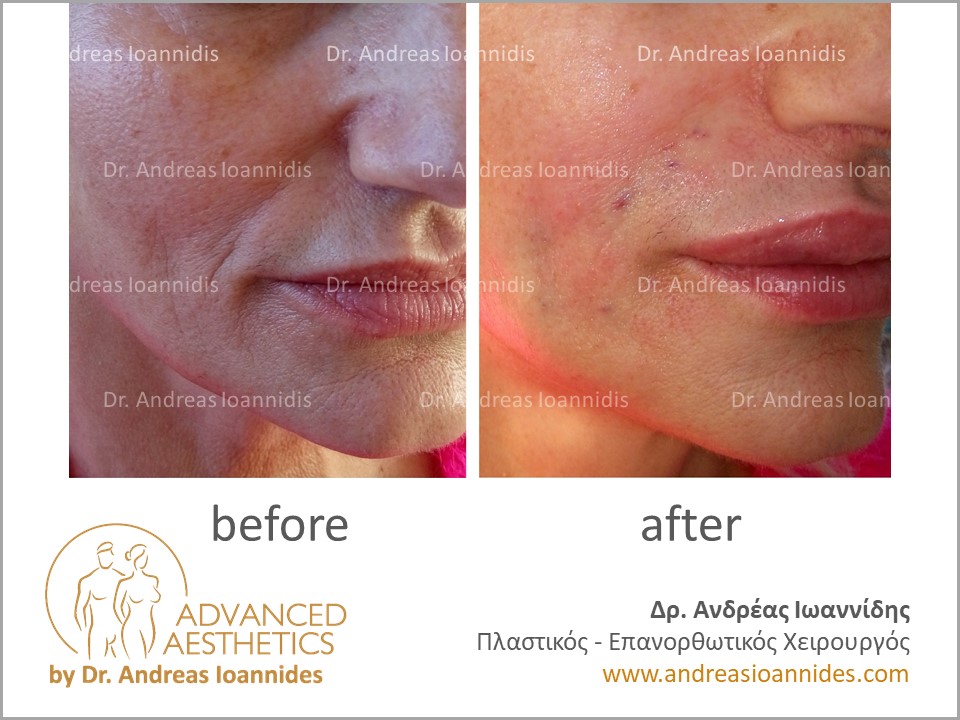
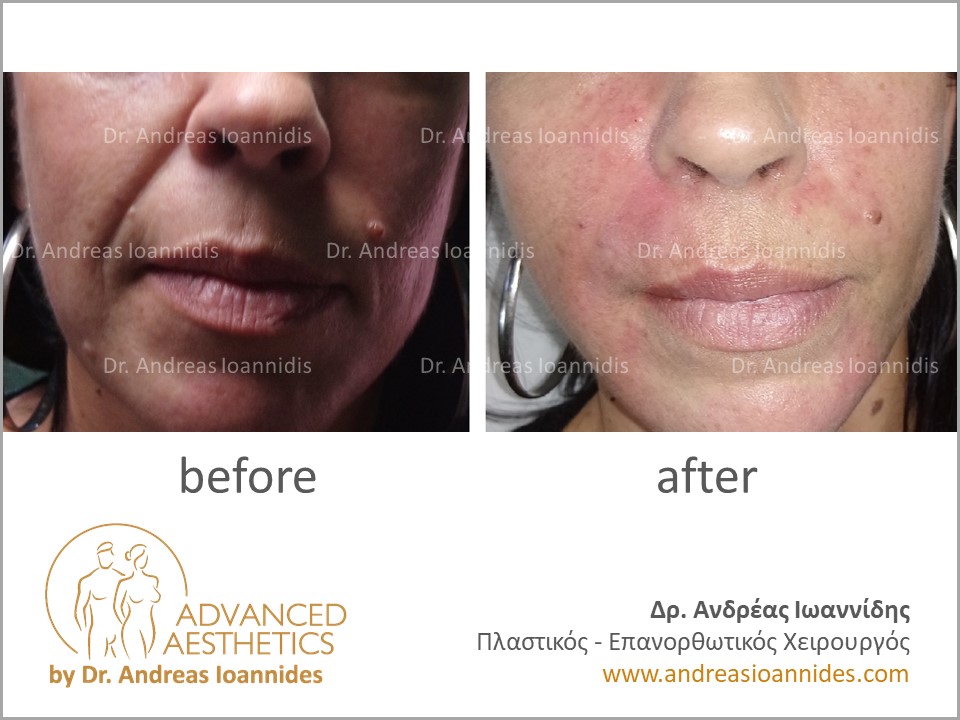
- deepening of the nasolabial folds,
- changes in the lips,
- wrinkles around the eyes,
- lines in the forehead and frown area,
- laxity in the lower face and neck.
Constant movement from:
- smiling,
- speaking,
- chewing,
- swallowing,
- facial expression,
also contributes to the development of dynamic and static lines. For this reason, modern facial rejuvenation does not treat every wrinkle with the same product.
What are facial fillers?
Facial fillers are injectable materials used to restore volume or improve specific anatomical areas. Depending on the product and technique, they may be used for:
- nasolabial folds,
- lips,
- cheekbones,
- chin,
- jawline,
- temples,
- the under-eye area in selected patients,
- fine or deeper lines,
- facial harmonisation,
- restoration of volume loss.
Not all fillers are the same. They differ in:
- composition,
- density,
- elasticity,
- duration,
- the areas for which they are most suitable.
Hyaluronic Acid
Hyaluronic acid is one of the most widely used injectable materials in aesthetic medicine. Different formulations and densities are available for different treatment goals. Depending on the product and area, it may be used for:
- lip enhancement,
- nasolabial folds,
- cheekbones,
- chin,
- jawline,
- temples,
- volume restoration,
- facial contouring.
The result is temporary and its duration varies according to:
- the product,
- the treatment area,
- the amount used,
- the patient’s metabolism,
- the mobility of the area.
In many cases, the result can last for several months or longer, although there is no single duration that applies to everyone.
Monophasic or biphasic hyaluronic acid?
Hyaluronic acid fillers can differ in manufacturing technology and rheological properties. The choice should not be based simply on a brand name. The doctor selects the appropriate product according to:
- injection depth,
- treatment area,
- movement of the area,
- whether volume or fine correction is needed,
- the desired result.
A filler that is ideal for the lips is not necessarily the right choice for the chin or cheekbones.
Collagen Biostimulators
Biostimulators do not work in exactly the same way as conventional fillers. Their purpose is to create a gradual biological response within the tissues and support new collagen production. They may be used when the aim is:
- improved skin quality,
- gradual improvement in firmness,
- restoration of selected volume,
- a more progressive and natural-looking result.
The effect is not necessarily immediate to the same degree as a hyaluronic acid filler. It develops gradually over time.
Polycaprolactone
Polycaprolactone (PCL) is used in certain injectable products as a biostimulatory material. Its effect may be associated with:
- immediate structural support depending on the product,
- gradual stimulation of collagen production,
- improvement in tissue quality,
- potentially longer-lasting results than some conventional fillers.
It is not suitable for every area or every patient. Its use should be determined after medical assessment and with detailed knowledge of the relevant anatomy.
Hyaluronic acid or biostimulator?
There is no single correct answer for everyone.
Hyaluronic Acid
It may be appropriate when the goal is:
- immediate volume,
- precise shaping,
- contour improvement,
- targeted correction.
Biostimulator
It may be more appropriate when the goal is:
- gradual rejuvenation,
- improved skin quality,
- support of collagen production,
- a more progressive result.
In some patients, a combination may be appropriate.
Facial Fat Transfer – Fat Grafting
Fat transfer / fat grafting is a different approach. Fat is taken from the patient’s own body and:
- collected using an appropriate technique,
- processed,
- transferred to selected areas of the face.
It may be used for:
- cheekbones,
- temples,
- midface,
- deeper folds,
- lips in selected patients,
- overall 3D volume restoration.
The fat that survives and integrates may remain long term. However, some of the transferred fat may be reabsorbed during the healing period.
Nanofat / Nanograft and facial rejuvenation
In selected cases, more refined fat-processing techniques such as Nanofat / Nanograft may be used. The aim may be:
- improvement in tissue quality,
- correction of small volume deficiencies,
- complementary facial rejuvenation.
The choice depends on the concern being treated and does not replace every other treatment.
Fillers for nasolabial folds
Nasolabial folds should not always be filled directly. In many patients, their deepening is mainly related to:
- midface descent,
- volume loss in the cheekbones,
- changes in cheek support.
For this reason, Dr Andreas Ioannides first evaluates the entire midface. Sometimes the most natural correction is achieved by restoring support elsewhere rather than placing excessive filler directly into the fold.
Lip Fillers
Lip enhancement may involve:
- volume,
- contour,
- asymmetry,
- upper-to-lower lip proportion,
- Cupid’s bow definition,
- improvement in hydration and texture.
The aim is not necessarily to create larger lips. The goal is to create lips that suit the individual face. Excessive filler can distort the natural anatomy and create heaviness.
Cheek Fillers
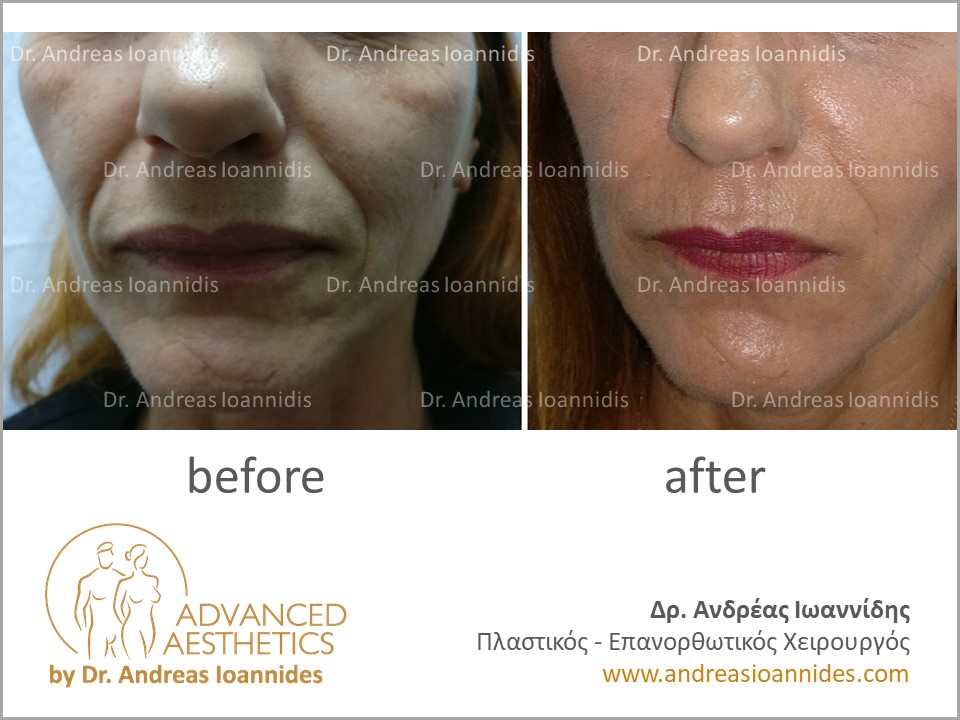
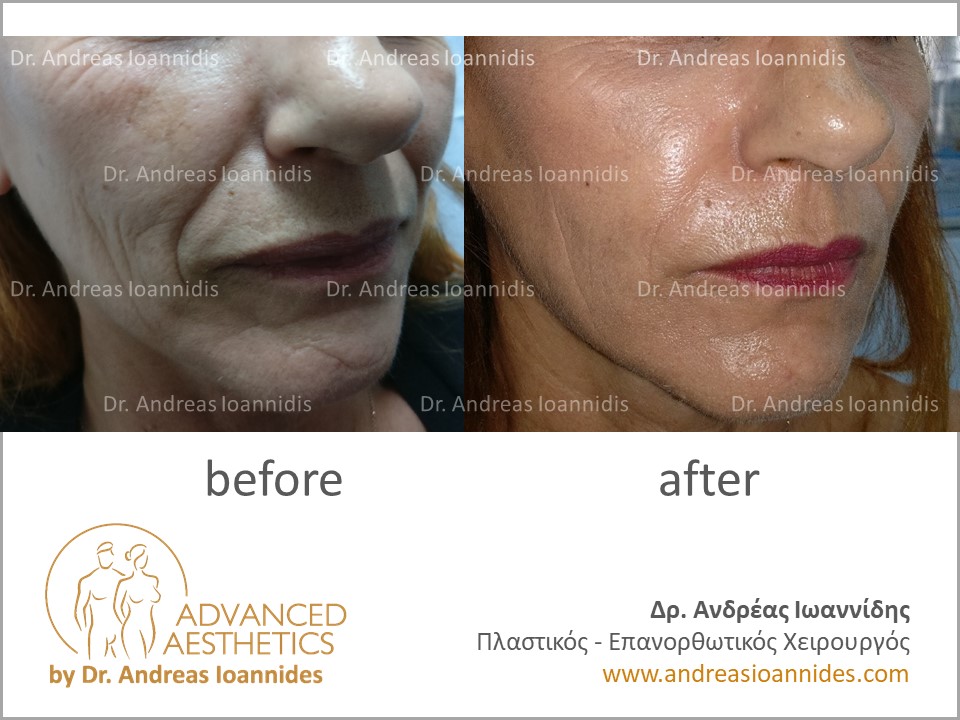
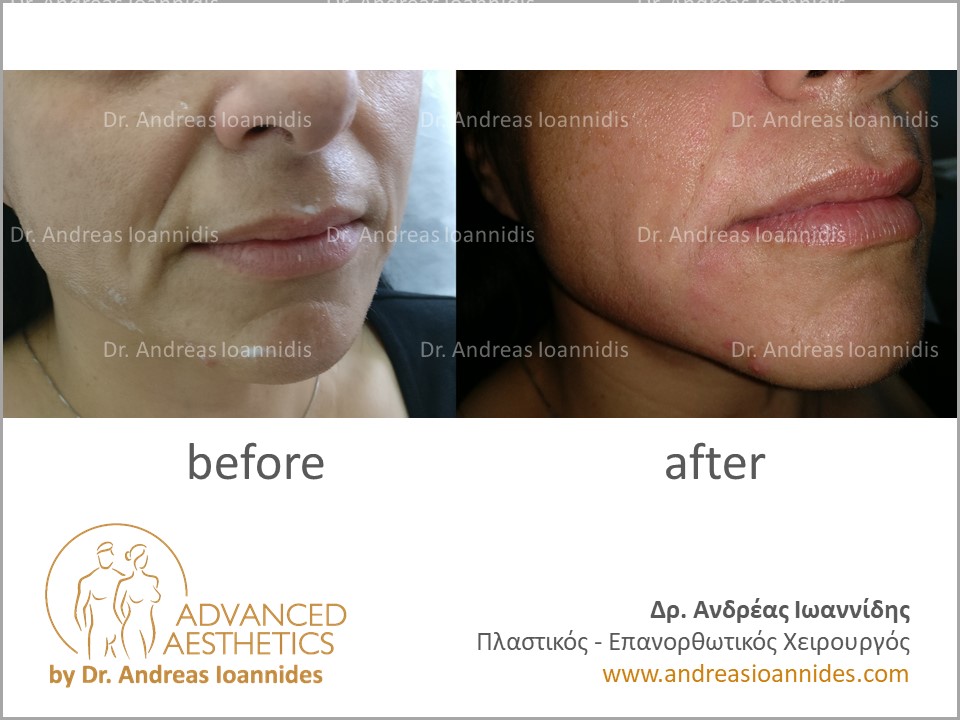
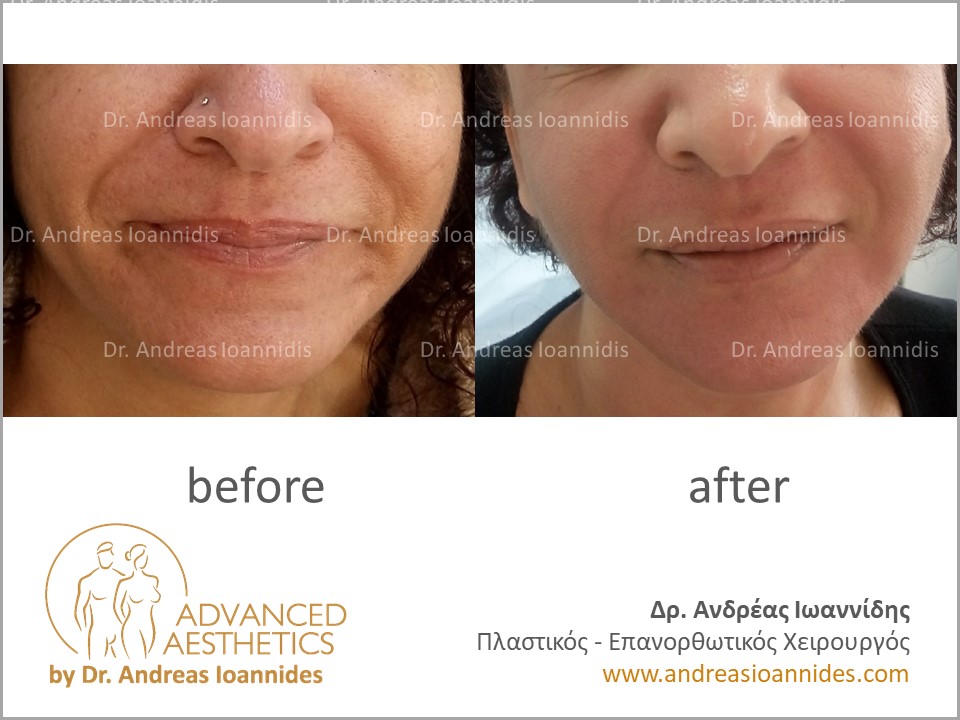
With ageing, support in the midface may decrease. Careful restoration of cheek volume may help:
- improve contour,
- support the cheek,
- recreate a more youthful three-dimensional facial architecture.
The amount used should be adapted to sex, age and natural facial structure.
Jawline and Chin Fillers
The chin and jawline have a major influence on the facial profile. In selected patients, fillers may improve:
- chin projection,
- symmetry,
- jaw angle,
- jawline definition,
- balance between the nose, lips and chin.
When there is a significant skeletal discrepancy, genioplasty or another surgical treatment may be more appropriate.
Full Face Rejuvenation
Modern facial rejuvenation does not treat the face “one wrinkle at a time”. In many patients, the best result comes from analysing the face as a whole:
- upper face,
- midface,
- lower face,
- lips,
- chin,
- jawline.
Full Face Rejuvenation may combine different products and techniques to create balanced correction without excess.
Why choose facial injectable treatments with Dr Andreas Ioannides?
Injection technique is just as important as the product itself. Dr Andreas Ioannides evaluates:
- the skeletal framework,
- vascular anatomy,
- facial fat compartments,
- muscle movement,
- skin thickness,
- natural proportions,
- age-related changes.
His background in plastic surgery allows the face to be approached not as a series of injection points, but as a three-dimensional anatomical structure. The result should be visible in the improvement — not in the product that was used.
Which filler is right for you?
There is no single product that is ideal for every area. The choice depends on:
- the type of concern,
- the area,
- the depth,
- movement,
- skin quality,
- whether an immediate or gradual effect is preferred,
- the desired duration.
In some patients, the right plan may not require filler at all. A better option may be:
- biostimulation,
- fat transfer,
- Botox,
- skin tightening,
- surgical lifting,
- or a combination of techniques.
How is the treatment performed?
The treatment area is assessed and planned before injection. Depending on the product, the doctor may use:
- a fine needle,
- a cannula,
- a combination of techniques.
The material is placed at different tissue levels depending on the treatment objective. The aim is to use the smallest appropriate amount in the correct location for a natural result.
Is anaesthesia required?
Many injectable products contain local anaesthetic or may be used together with:
- numbing cream,
- local anaesthesia,
- other techniques to reduce discomfort.
The experience varies depending on the area and the product.
How long does treatment take?
Treatment time depends on:
- the number of areas,
- the product,
- whether full-face treatment is performed,
- whether several techniques are combined.
A small treatment may be completed relatively quickly, while a more comprehensive facial harmonisation plan requires more time.
What is recovery like?
After treatment, patients may experience:
- mild swelling,
- redness,
- tenderness,
- small bruises,
- a feeling of tightness.
These effects are usually temporary. Their intensity and duration vary according to:
- the area,
- the amount injected,
- the product,
- the technique,
- the individual patient.
When can I return to work?
In many cases, return to normal activities is immediate or very quick. However, temporary swelling or bruising may affect social recovery. There is therefore no identical recovery time for everyone.
What should I avoid after fillers?
Patients should always follow the specific instructions provided by their doctor. In many cases, temporary avoidance may be advised for:
- strenuous exercise,
- excessive heat,
- sauna,
- steam rooms,
- strong massage of the area,
- prolonged sun exposure.
In countries with strong sunlight, such as Greece and Cyprus, appropriate sun protection is especially important when swelling or bruising is present.
When will I see the results?
It depends on the material used.
Hyaluronic Acid
The result is visible immediately, although the final appearance is assessed after initial swelling settles.
Biostimulators
The result develops gradually as collagen production is stimulated.
Fat Transfer
There is an initial change, but the final result is assessed after swelling decreases and the surviving fat has stabilised.
How long do the results last?
Duration depends on:
- the material,
- the treatment area,
- the amount used,
- metabolism,
- movement,
- technique.
Hyaluronic acid fillers are temporary. Biostimulators may provide a longer-lasting effect through gradual collagen production. Fat transfer may provide long-term results for the proportion of fat that successfully integrates.
Are fillers safe?
Fillers are medical injectable treatments and are not without risk. Potential adverse effects may include:
- swelling,
- bruising,
- asymmetry,
- nodules,
- inflammation,
- infection,
- unwanted distribution of the product,
- vascular complications.
Vascular complications are rare but can be serious. For this reason, treatment should be performed by a doctor with detailed anatomical knowledge and the ability to recognise and manage potential complications.
How much do facial fillers cost?
The cost of facial injectable treatments varies from patient to patient. The final price depends on:
- the product,
- the amount required,
- the number of areas,
- the type of treatment,
- whether hyaluronic acid or a biostimulator is used,
- whether full-face treatment is performed,
- whether different techniques are combined.
For this reason, the exact price is determined after a personal consultation.
Natural results without excess
Facial Injectables by Dr Andreas Ioannides Modern aesthetic medicine should not change the defining features of the face. The aim is:
- to restore volume only where genuinely needed,
- to preserve movement,
- to maintain natural proportions,
- to avoid overfilling,
- to create a result that develops harmoniously with the face.
The goal is not for people to notice your filler. The goal is for you to look more rested, balanced and refreshed.
Would you like to know which injectable treatment is right for you?
During your personal consultation, Dr Andreas Ioannides will assess:
- skin quality,
- volume loss,
- wrinkles,
- cheekbones,
- lips,
- chin,
- jawline,
- overall facial proportions,
- your desired result.
The most appropriate plan can then be designed, which may include:
hyaluronic acid, biostimulators, polycaprolactone, fat transfer, Nanofat / Nanograft or a combination of techniques.
Frequently Asked Questions About Facial Injectables
They are injectable materials used to restore volume, improve contour and soften selected lines.
There is no single best filler for everyone. The choice depends on the area, anatomy and treatment objective.
Duration varies according to the product, treatment area and the patient’s metabolism, and commonly lasts for several months or longer.
A biostimulator is an injectable material used to stimulate gradual collagen production and improve tissue quality.
Polycaprolactone is a biocompatible material used in certain biostimulatory fillers to provide structural support and stimulate collagen production.
They are different techniques. Fat transfer uses the patient’s own fat and may be suitable for broader 3D volume restoration, while fillers allow more immediate and targeted shaping.
Yes, when clinically appropriate. The amount and product are selected according to natural anatomy and the desired result.
Yes, in selected patients fillers may improve chin projection and jawline definition.
In many cases, patients can return immediately, although temporary swelling or bruising may occur.
Most modern fillers are not permanent. Duration depends on the product and treatment area.
Injectable treatments carry potential risks and should be performed by an appropriately trained doctor with detailed anatomical knowledge.
The cost depends on the product, the amount required and the number of treatment areas. The exact price is determined after a personal consultation.
CONTACT

Dr. Andreas Ioannides
Contact us and book an appointment immediately
Choose your appointment by video call or by visiting one of our clinics!

Dr. Andreas Ioannides Executive Plastic Surgery is one of the most complete plastic surgery clinics and the international medical aesthetic medical centers ADVANCED AESTHETICS provide modern medical techniques and aesthetic medical treatments in Greece and Cyprus.
7 Common Myths About Plastic Surgery
Blepharoplasty: When Is It Indicated and What to Expect During Recovery
Rhinoplasty and Breathing: Can Aesthetics and Functionality Be Combined?
September and Plastic Surgery: Why Autumn Can Be a Good Time to Plan an Aesthetic Procedure
September and Aesthetic Treatments: Why It’s the Ideal Time for a Fresh Start
Thinking About Labiaplasty? 10 Things You Should Know Before Moving Forward
Labiaplasty: Everything You Need to Know About the Procedure That Improves Comfort and Confidence
Athens Clinic
T +30.210 9595566
Email: info@andreasioannides.com
Address: Syggrou Ave, 284, Kallithea, Zip 17673 – Athens
Cyprus Clinics
T +357.22335002
Email: info@andreasioannides.com
Athenium International Medical Institute
Address: Giannitson 9 Strovolos, Nicosia 2027, Cyprus
Address: Thiseos 1, Lemesos 3025, Zip 4004 – Cyprus
Copyright © 2022