


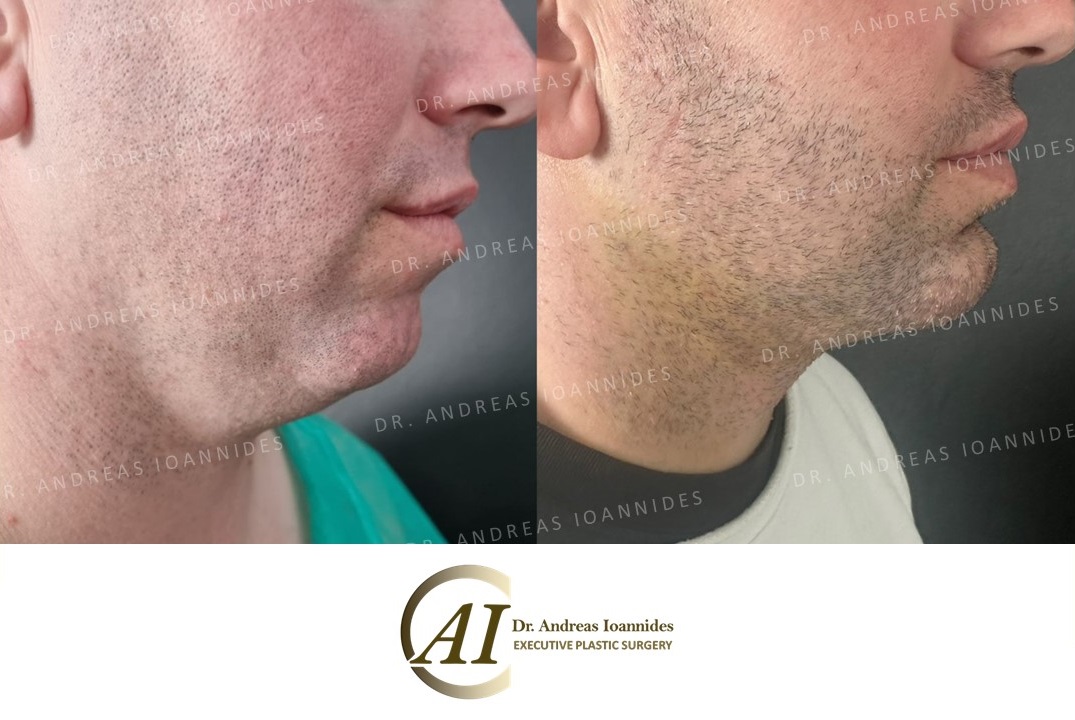
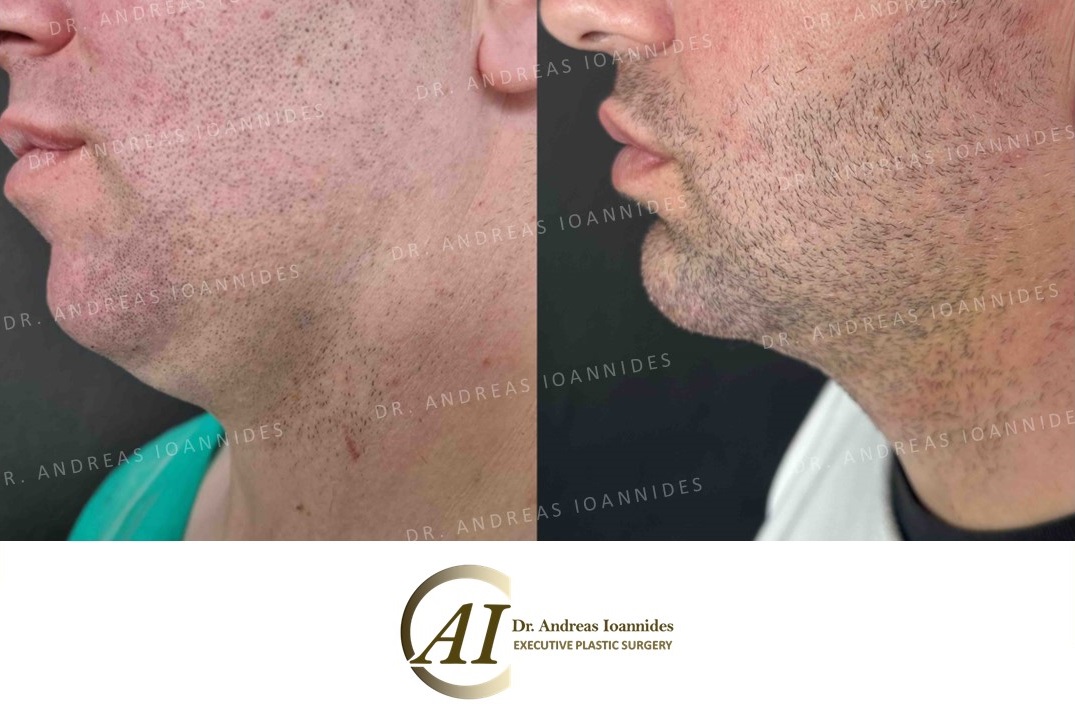
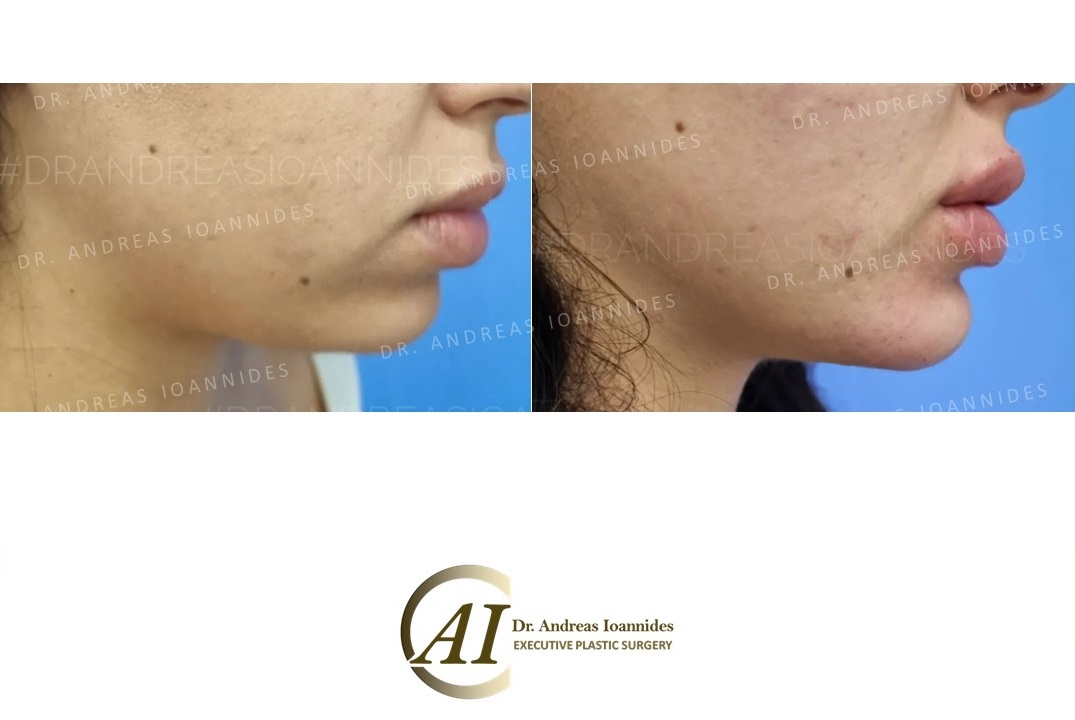
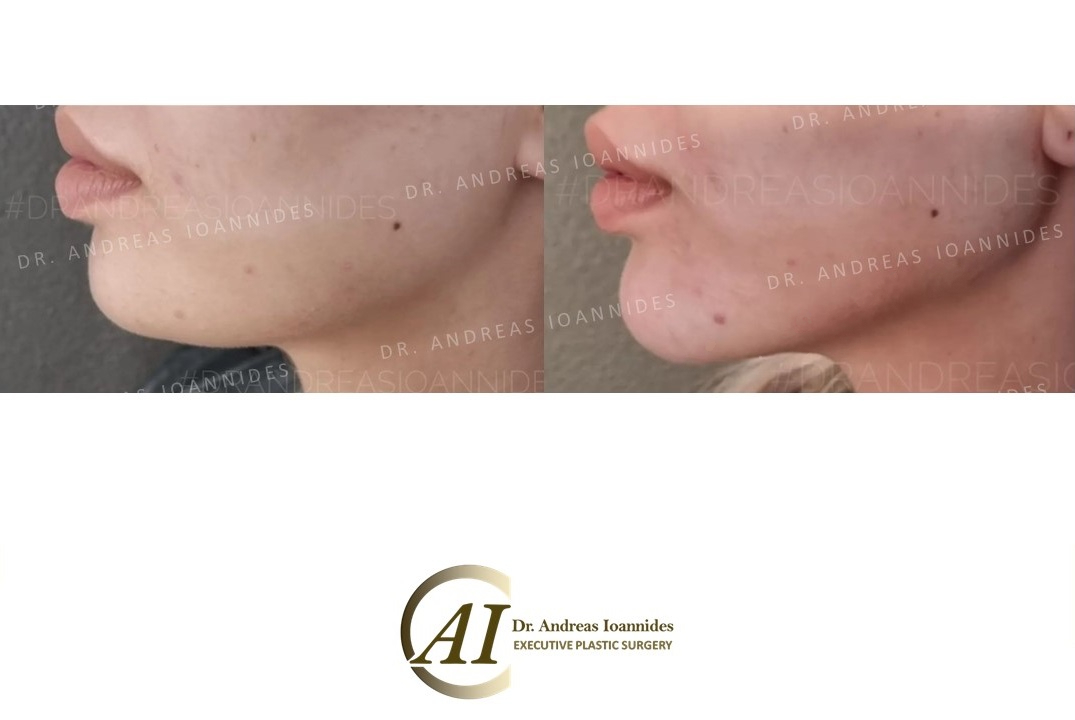
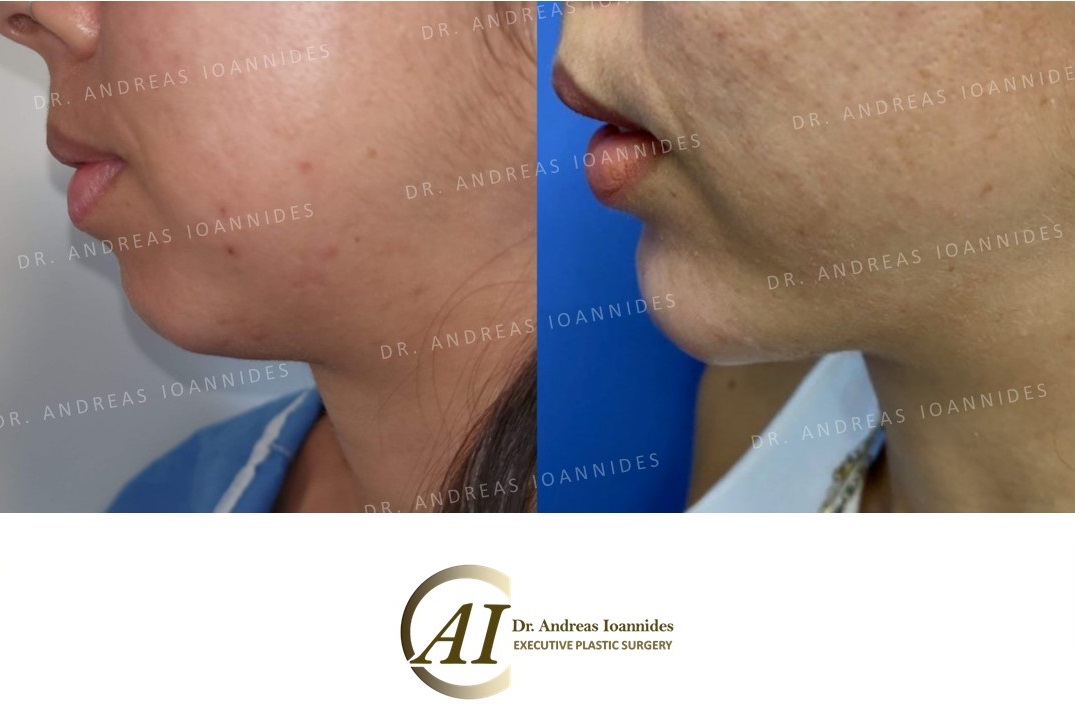
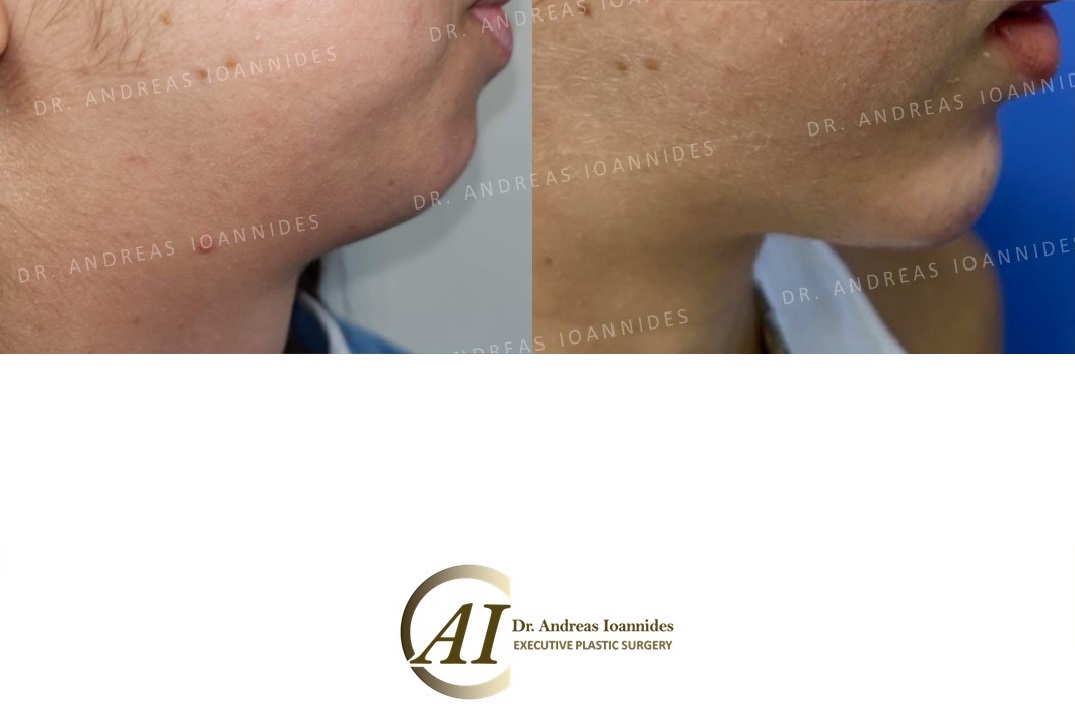
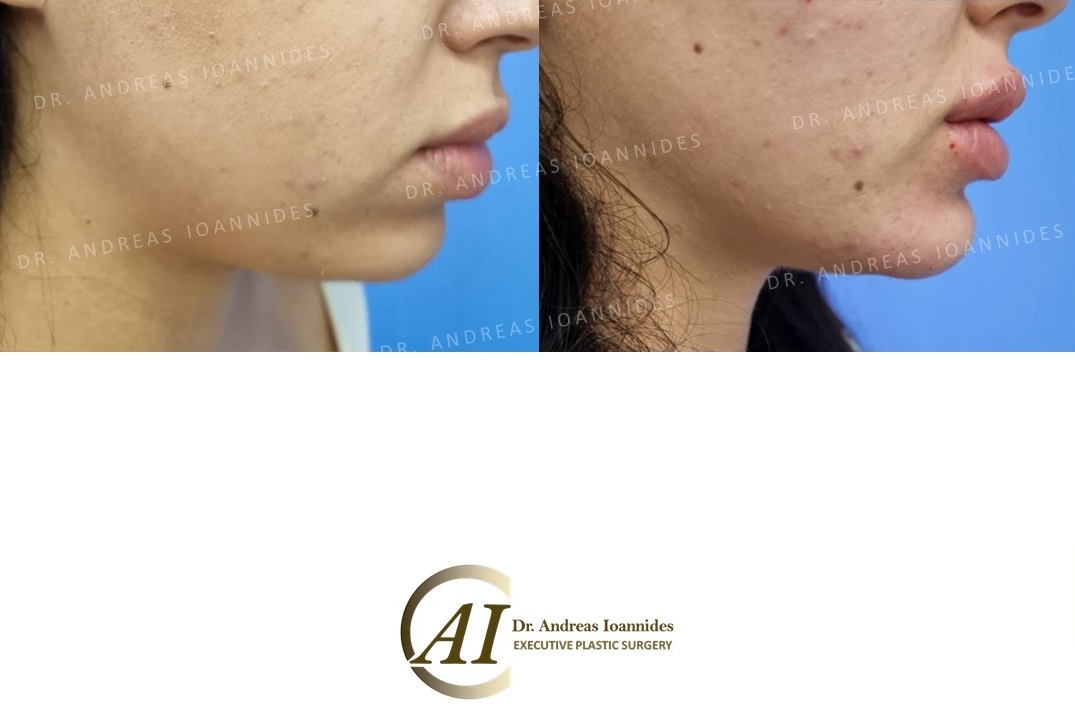
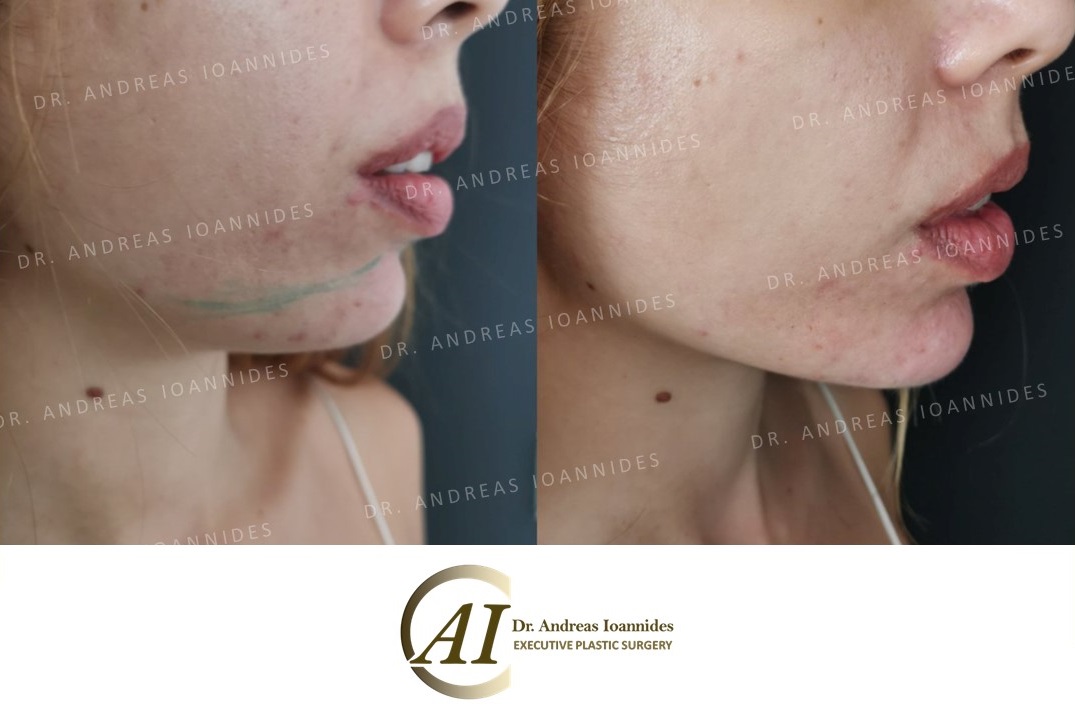
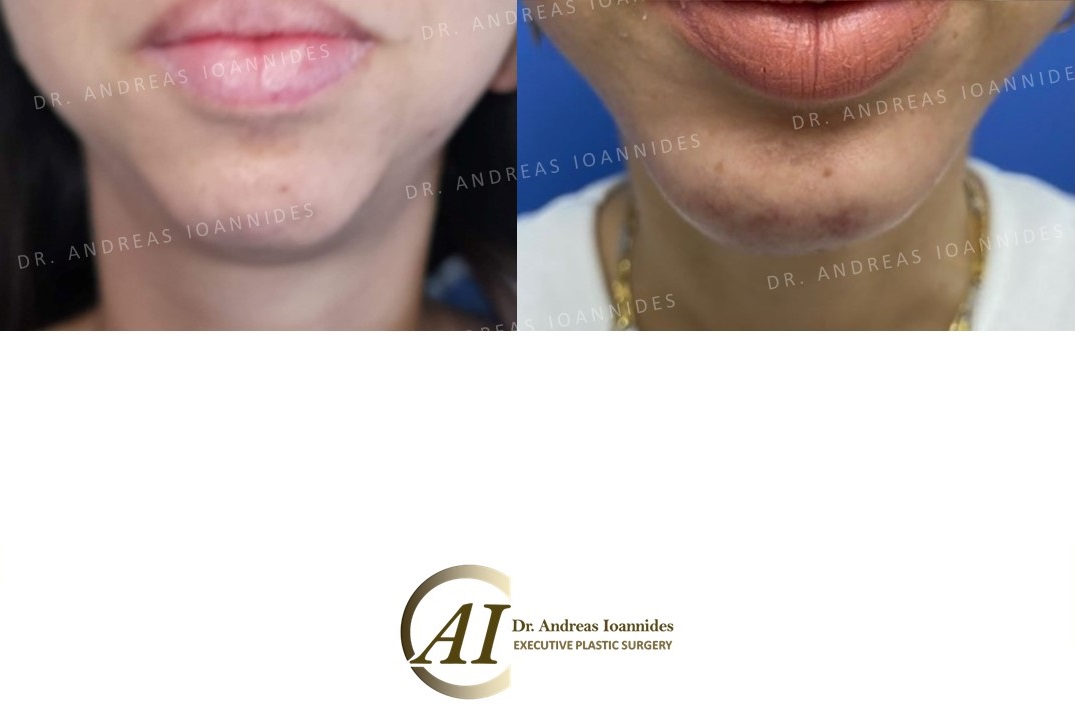
Liquid Chin Contouring is a non-surgical injectable treatment designed to improve the projection, shape and symmetry of the chin. The chin is one of the key structural features that defines facial balance. Even a relatively small anatomical difference can influence:
- the facial profile,
- the relationship between the nose and chin,
- jawline definition,
- lower-face proportions,
- overall facial harmony.
Two of the most common aesthetic concerns are microgenia and retrogenia, where the chin appears underdeveloped or positioned too far back in relation to the rest of the face. In appropriately selected patients, injectable chin contouring may provide immediate improvement without implants and without the recovery associated with surgical genioplasty. The goal is not simply to make the chin larger. The goal is to improve the proportions of the entire face.
What is Liquid Chin Contouring?
Liquid Chin Contouring is a non-surgical technique in which a selected injectable material is strategically placed in the chin area. Treatment may be used to:
- enhance projection,
- increase vertical length where appropriate,
- improve chin shape,
- correct mild asymmetry,
- improve the transition into the jawline,
- enhance the balance between the nose, lips and chin.
The result is planned in three dimensions. The chin is not treated as an isolated feature, but as part of the overall facial architecture.
What is Microgenia?
Microgenia refers to a chin that is relatively small or underdeveloped compared with the rest of the face. It may create the appearance of:
- a weaker lower face,
- reduced profile projection,
- greater visual emphasis on the nose,
- a less defined jawline.
In mild and selected cases, it may be improved with injectable contouring. When there is a significant skeletal discrepancy, surgical treatment may be more appropriate.
What is Retrogenia?
Retrogenia describes a chin positioned further back than ideal in the facial profile. This may affect:
- profile balance,
- the relationship with the nose,
- neck definition,
- the mandibular angle,
- the overall lower face.
In suitable patients, injectable enhancement may improve projection without surgically repositioning the bone.
Why is the Chin so important for the facial profile?
Facial harmony does not depend on one feature alone. The nose, lips, chin, jawline and neck work together as a single visual unit. An under-projected chin may make:
- the nose appear larger,
- the neck look less defined,
- the jawline appear weaker,
- the lower face look less balanced.
For this reason, even a relatively small change in chin projection may significantly improve the appearance of the profile.
How is Liquid Chin Contouring performed?
Following a detailed facial assessment, Dr Andreas Ioannides plans:
- the point of projection,
- vertical length,
- width,
- the relationship with the jawline,
- balance with the nose and lips.
The selected injectable material is then placed at specific anatomical points and tissue levels. The aim is to create support and projection without excessive volume.
What type of injectable materials can be used?
Modern aesthetic medicine includes several categories of injectable materials. Depending on the indication, options may include:
- absorbable fillers,
- biostimulatory materials,
- longer-lasting injectable options,
- autologous techniques such as fat transfer in selected patients.
Not every material is suitable for every patient. Selection depends on:
- the type of correction required,
- anatomy,
- the desired duration,
- tissue quality,
- previous treatment history.
Why are permanent fillers often avoided?
Although permanent injectable materials have historically been used, the modern approach is generally more cautious. A permanent material can be more difficult to correct or remove if:
- facial proportions change with ageing,
- an adverse reaction develops,
- the aesthetic result is no longer desirable.
For this reason, product selection should be discussed carefully with the plastic surgeon.
What can Liquid Chin Contouring correct?
In selected patients, treatment may help improve:
- microgenia,
- mild retrogenia,
- small asymmetries,
- reduced projection,
- the need for greater lower-face length,
- the transition from chin to jawline,
- overall profile balance.
The degree of correction depends on the underlying skeletal anatomy.
Chin Contouring and Jawline Definition
The chin is the central point of the lower face. In many patients, improving chin projection alone can create:
- a cleaner jawline,
- better symmetry,
- stronger profile projection,
- improved lower-face balance.
In others, chin enhancement may need to be combined with jawline contouring. The aim is to create a continuous, natural lower-face contour rather than an isolated or overfilled chin.
Liquid Chin Contouring and Rhinoplasty
The relationship between the nose and chin is extremely important in profile aesthetics. In patients with a small or retruded chin, the nose may appear larger than it actually is. For this reason, chin projection should also be assessed when planning rhinoplasty. In selected cases, chin enhancement may:
- significantly improve the profile,
- create better facial balance,
- complement the result of rhinoplasty.
Non-Surgical or Surgical Genioplasty?
These treatments do not have the same capabilities.
Liquid Chin Contouring
May be suitable when there is:
- mild microgenia,
- mild retrogenia,
- a need for small or moderate projection,
- minor asymmetry,
- a preference to avoid surgery.
Surgical Genioplasty
May be more appropriate when there is:
- significant skeletal underdevelopment,
- a need for major chin movement,
- marked asymmetry,
- a need for permanent structural correction.
In these cases, osteotomy or another surgical technique may be required.
Liquid Chin Contouring or Chin Implant?
A chin implant is a surgical option that provides permanent structural projection. An injectable approach may be more suitable for a patient who:
- does not want surgery,
- wants a more limited change,
- wants shorter recovery,
- does not require major skeletal correction.
An implant may be more appropriate when greater and more stable augmentation is required.
When will I see the result?
With most injectable contouring techniques, the change is visible immediately. However, the final result should not be judged immediately. During the first few days, there may be:
- swelling,
- mild tenderness,
- minor bruising,
- a feeling of tightness.
As these settle, the new contour becomes clearer. With biostimulatory treatments, part of the result may continue to develop gradually.
How long does the procedure take?
A limited chin treatment can usually be completed relatively quickly. In many cases, treatment takes approximately 15–30 minutes, depending on:
- the material used,
- the degree of correction,
- the number of injection points,
- the overall treatment plan.
Is anaesthesia required?
Treatment is usually performed with:
- topical anaesthetic cream,
- local injectable anaesthesia where required,
- products that may contain local anaesthetic,
- fine needles or cannulas.
General anaesthesia is not required for a standard injectable chin treatment.
Is there downtime?
Downtime is usually limited. Temporary effects may include:
- swelling,
- redness,
- bruising,
- tenderness,
- a feeling of pressure.
Most patients return quickly to normal daily activities.
When can I return to work?
In many cases, patients may return the same day or the following day. Social downtime depends mainly on:
- swelling,
- possible bruising,
- the amount of correction,
- individual response.
How long do the results last?
Duration depends on:
- the material used,
- the amount,
- the treatment area,
- metabolism,
- tissue movement,
- individual response.
There is no single duration that applies to every patient. Absorbable injectable materials gradually reduce over time, while biostimulatory treatments may have a different duration and progression.
Is Liquid Chin Contouring safe?
This is a medical injectable procedure and is not completely risk-free. Possible adverse effects may include:
- swelling,
- bruising,
- asymmetry,
- nodules,
- infection,
- inflammation,
- unwanted product distribution,
- vascular complications.
Vascular complications are rare but can be serious. For this reason, detailed anatomical knowledge and correct injection technique are essential.
Why choose Dr Andreas Ioannides?
Chin contouring should not be planned by looking at the chin alone. Dr Andreas Ioannides, Plastic & Reconstructive Surgeon, evaluates the relationship between:
- the nose,
- the lips,
- the chin,
- the jawline,
- the neck,
- the facial profile,
- overall facial proportions.
His surgical background also allows him to assess whether the concern can truly be corrected with an injectable treatment or whether surgical genioplasty would provide a better result. Successful chin contouring is not about using more filler. It is about the right projection, the right angle and the right proportions.
Who is a suitable candidate?
Treatment may be suitable for women and men who:
- have a small or mildly retruded chin,
- want greater projection,
- want to improve their profile,
- want a cleaner lower-face contour,
- have small asymmetries,
- do not want surgery,
- want limited downtime,
- have realistic expectations.
When is Liquid Chin Contouring not enough?
Injectable treatment has clear limitations. When there is:
- severe microgenia,
- significant skeletal asymmetry,
- marked retrogenia,
- major bite abnormalities,
- a need for significant chin repositioning,
surgical or maxillofacial treatment may be required.
Can it be combined with other treatments?
Yes. Depending on the anatomy, non-surgical chin contouring may form part of a broader facial contouring plan. It may be combined with:
- jawline contouring,
- Botox in selected areas,
- Liquid Nose Reshaping,
- midface treatments,
- neck treatments,
- other facial-balancing techniques.
The goal is overall facial harmony rather than over-correction of one feature.
How much does Liquid Chin Contouring cost?
The cost varies according to the personalised treatment plan. The final price depends on:
- the material used,
- the amount required,
- the degree of correction,
- whether jawline contouring is also needed,
- whether it is combined with other facial contouring treatments.
For this reason, the exact price is determined after a personal consultation.
The right Chin can transform the entire profile.
Liquid Chin Contouring by Dr Andreas Ioannides A successful result should not make the chin look “filled”. It should create:
- better balance,
- appropriate projection,
- a cleaner jawline,
- harmony with the nose,
- a natural lower face.
The best result is one that improves the face without making the treatment itself obvious.
Would you like to know if Liquid Chin Contouring is right for you?
During your personal consultation, Dr Andreas Ioannides will assess:
- chin projection,
- chin length and width,
- symmetry,
- jawline,
- the relationship with the nose,
- profile balance,
- skeletal anatomy,
- your desired result.
The most appropriate treatment may then include:
Liquid Chin Contouring, surgical genioplasty, chin implant, fat transfer or a combined Facial Profile Contouring approach.
Frequently Asked Questions About Liquid Chin Contouring
It is a non-surgical injectable technique used to improve chin projection, shape and facial proportions.
Microgenia refers to an underdeveloped or relatively small chin compared with the rest of the face.
Retrogenia refers to a chin positioned too far back in relation to ideal facial profile proportions.
In mild and selected cases, injectable treatment can improve projection and make the chin appear more proportionate.
Yes. Better chin projection can contribute to a cleaner and more defined lower-face contour.
Improving nose-to-chin balance can create a more harmonious profile and reduce the visual dominance of the nose.
Usually around 15–30 minutes, depending on the extent of treatment and the material used.
Downtime is usually limited, although swelling or bruising may occur.
With most injectable techniques, the result is immediately visible, while the final appearance is assessed after initial swelling subsides.
It depends on the material used. Many modern injectable products are absorbable and gradually decrease over time.
Not when there is a significant skeletal discrepancy or a need for major chin repositioning.
The price depends on the material, amount required and degree of correction, and is determined after a personal consultation.
CONTACT

Dr. Andreas Ioannides
Contact us and book an appointment immediately
Choose your appointment by video call or by visiting one of our clinics!

Dr. Andreas Ioannides Executive Plastic Surgery is one of the most complete plastic surgery clinics and the international medical aesthetic medical centers ADVANCED AESTHETICS provide modern medical techniques and aesthetic medical treatments in Greece and Cyprus.
7 Common Myths About Plastic Surgery
Blepharoplasty: When Is It Indicated and What to Expect During Recovery
Rhinoplasty and Breathing: Can Aesthetics and Functionality Be Combined?
September and Plastic Surgery: Why Autumn Can Be a Good Time to Plan an Aesthetic Procedure
September and Aesthetic Treatments: Why It’s the Ideal Time for a Fresh Start
Thinking About Labiaplasty? 10 Things You Should Know Before Moving Forward
Labiaplasty: Everything You Need to Know About the Procedure That Improves Comfort and Confidence
Athens Clinic
T +30.210 9595566
Email: info@andreasioannides.com
Address: Syggrou Ave, 284, Kallithea, Zip 17673 – Athens
Cyprus Clinics
T +357.22335002
Email: info@andreasioannides.com
Athenium International Medical Institute
Address: Giannitson 9 Strovolos, Nicosia 2027, Cyprus
Address: Thiseos 1, Lemesos 3025, Zip 4004 – Cyprus
Copyright © 2022