


PCL Skin Regeneration Therapy for collagen stimulation, skin tightening and improved skin quality
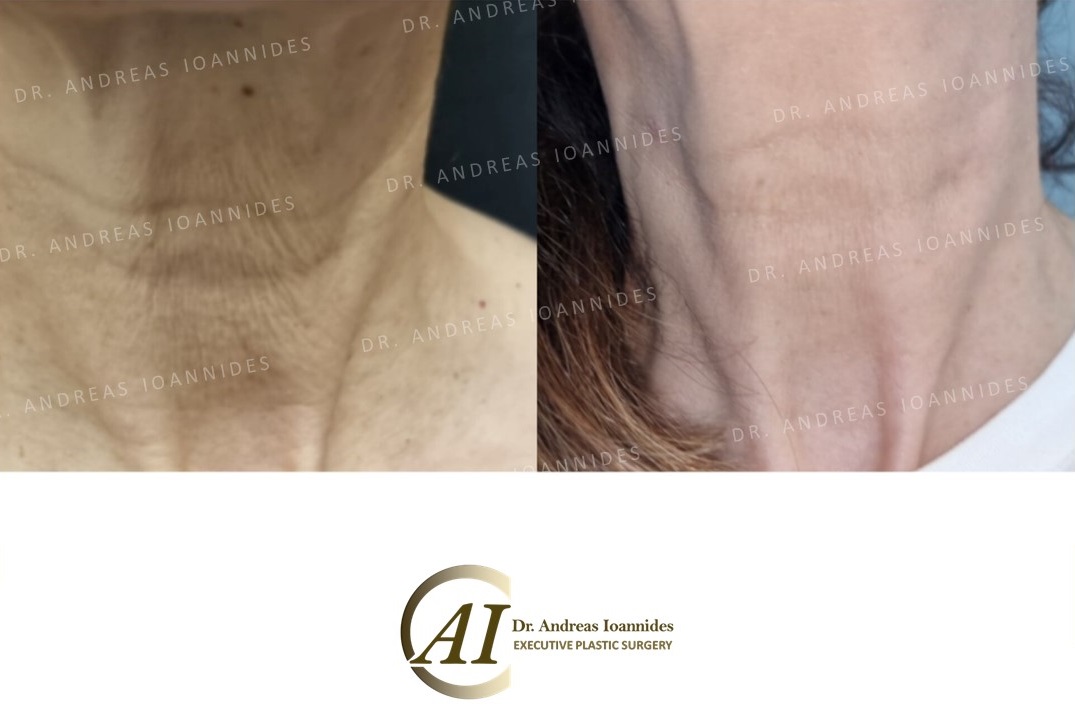
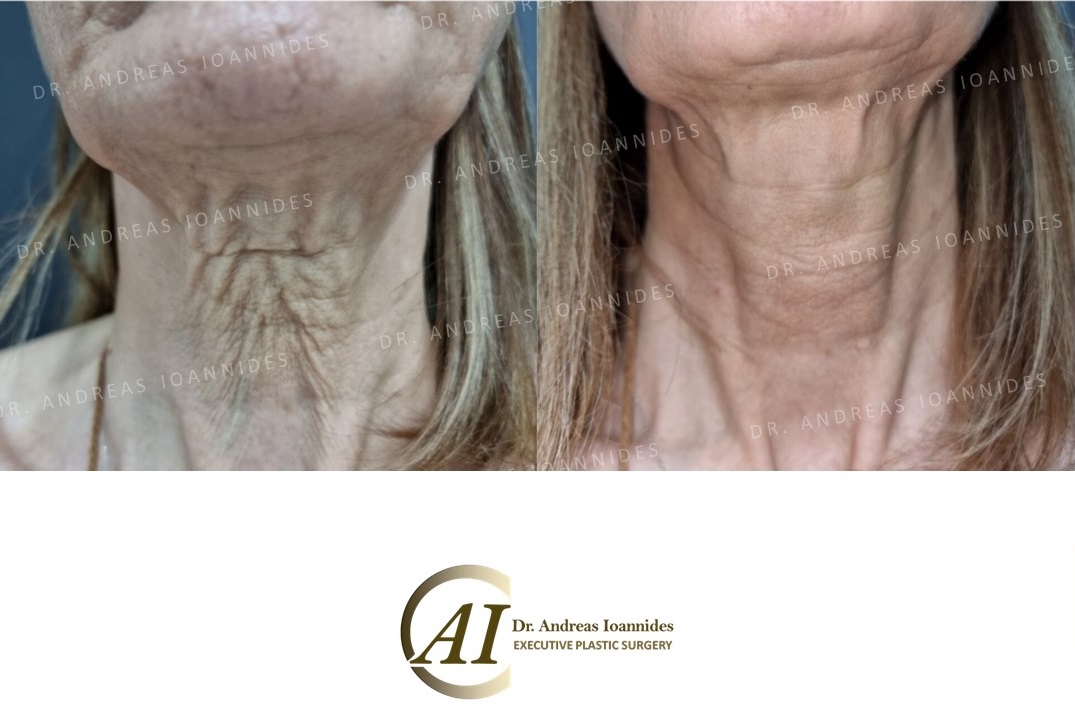
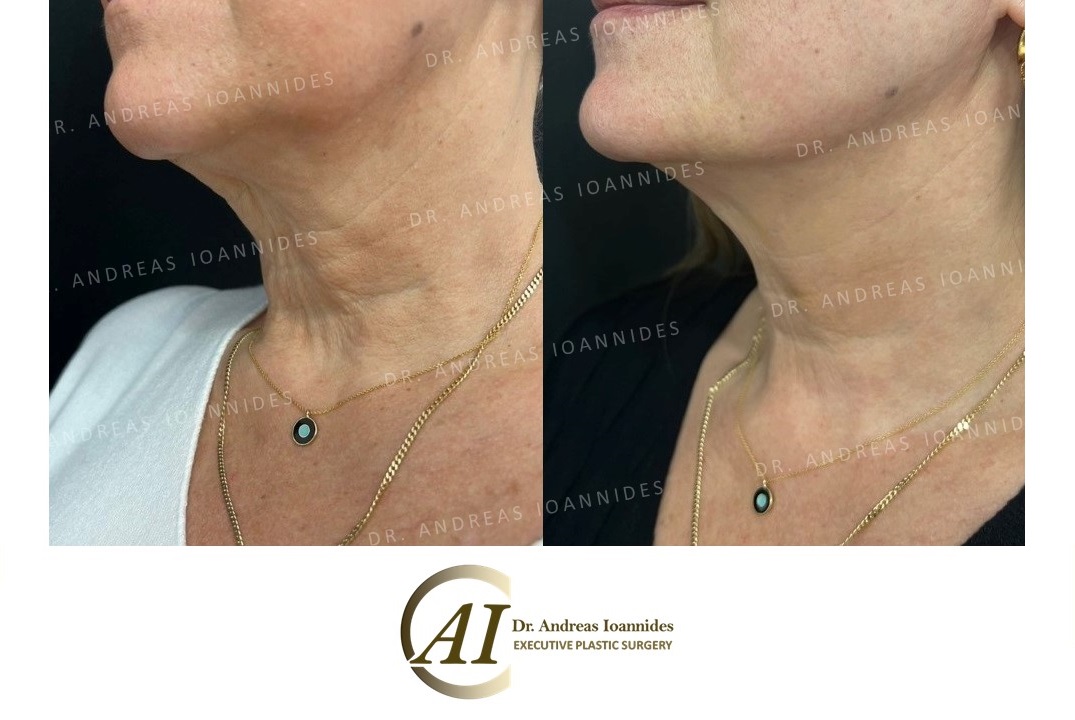
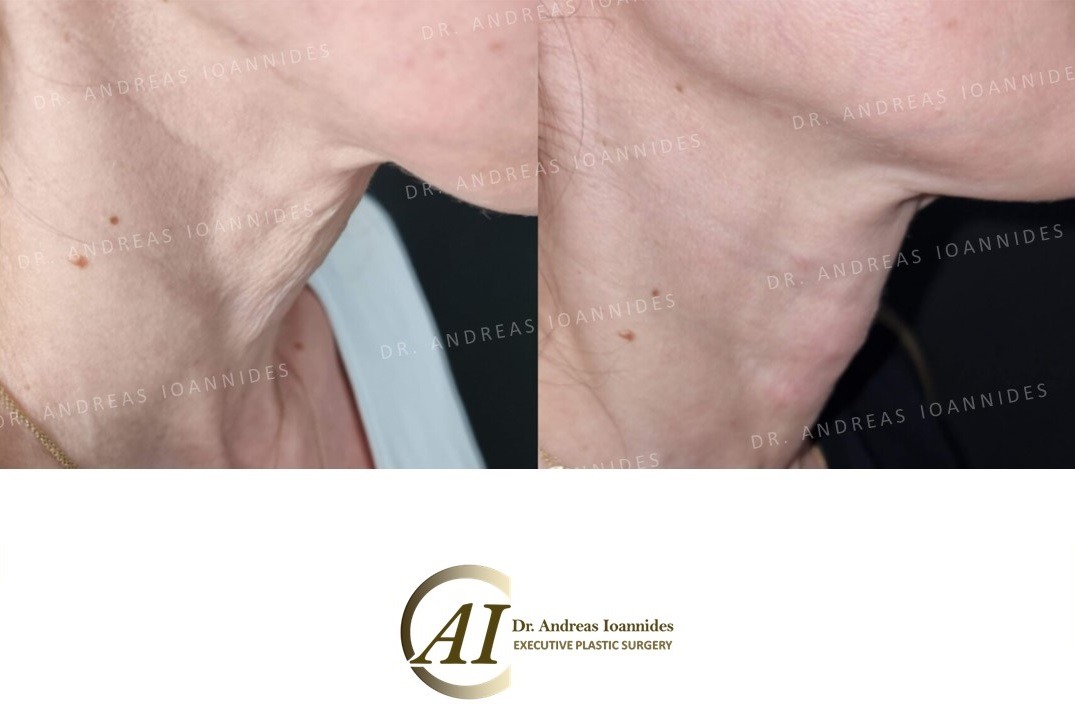
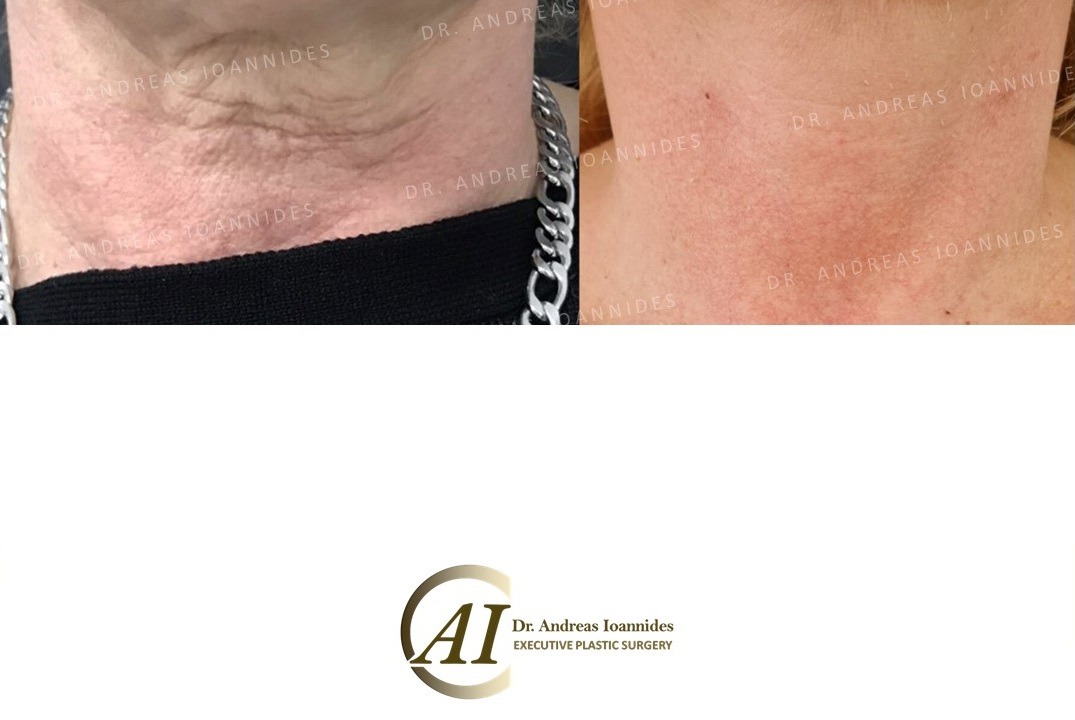
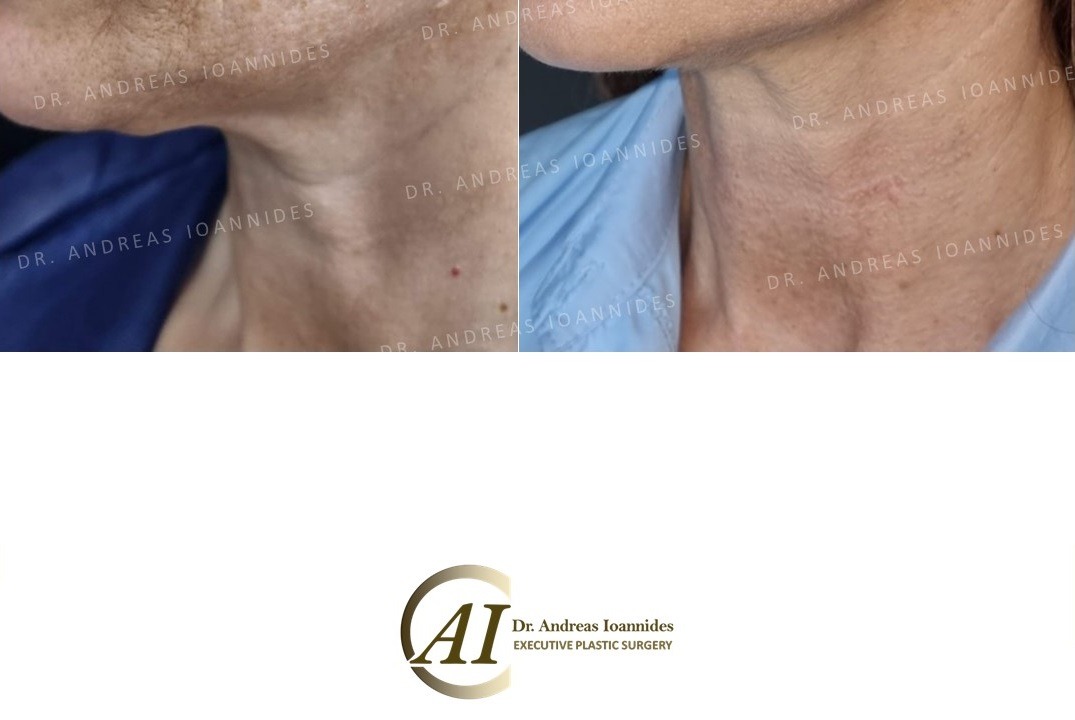
P.S.R. Neck Therapy – PCL Skin Regeneration Therapy is a personalised injectable rejuvenation approach developed and applied by Dr Andreas Ioannides for the neck and décolleté.
The treatment is designed to improve some of the most common signs of ageing in these delicate areas, including:
- skin laxity,
- fine lines and creasing,
- thinning of the skin,
- loss of firmness,
- reduced skin quality,
- age-related changes caused by sun exposure.
The treatment uses new-generation injectable biostimulatory materials, selected according to the patient’s skin quality and individual needs, with the aim of stimulating collagen production and supporting gradual tissue regeneration.
The goal is not to create artificial volume. The goal is to improve the quality, firmness and appearance of the skin itself.
What is P.S.R. Neck Therapy?
P.S.R. stands for PCL Skin Regeneration Therapy.
It is a treatment concept designed for the neck and décolleté, where ageing often becomes visible earlier because the skin is:
- thinner,
- more delicate,
- exposed to sunlight,
- constantly moving,
- more prone to fine lines and laxity.
The treatment focuses on improving the tissue environment through the use of biostimulatory injectable materials.
Depending on the indication, the treatment may aim to support:
- collagen production,
- gradual skin tightening,
- improvement in texture,
- reduction in the appearance of fine lines,
- restoration of a healthier and more youthful-looking skin quality.
Why does the neck age differently from the face?
The neck and décolleté have different anatomical characteristics from the face.
These areas may show:
- fine horizontal neck lines,
- crepey skin,
- loss of elasticity,
- thinning,
- pigmentation changes,
- sun damage,
- laxity,
- loss of structural support.
Many people focus on facial rejuvenation but notice that the neck and décolleté continue to reveal signs of ageing.
For this reason, these areas often require a dedicated treatment plan rather than simply extending a facial filler treatment downward.
How does P.S.R. Neck Therapy work?
The treatment uses injectable materials selected for their biostimulatory properties.
Rather than working only as traditional fillers, these materials are intended to stimulate biological activity in the tissues and support new collagen production.
This may lead to gradual improvement in:
- firmness,
- skin texture,
- fine lines,
- elasticity,
- overall tissue quality.
The result develops progressively as the skin responds to treatment and collagen remodelling takes place.
What is PCL?
PCL, or polycaprolactone, is a biocompatible material used in selected biostimulatory injectable products.
Depending on the formulation and indication, PCL-based products may provide:
- structural support,
- collagen stimulation,
- gradual improvement in skin quality,
- longer-lasting tissue remodelling compared with some conventional fillers.
PCL is not appropriate for every patient or every anatomical area.
Its use requires careful product selection, correct injection depth and detailed anatomical knowledge.
What concerns can P.S.R. Neck Therapy address?
The treatment may be considered for patients with:
- mild to moderate neck laxity,
- fine horizontal lines,
- crepey skin,
- thinning of the skin,
- reduced firmness,
- early age-related changes,
- sun-related deterioration in skin quality,
- loss of smoothness in the décolleté.
The exact degree of improvement varies from patient to patient.
P.S.R. Neck Therapy for skin tightening
One of the main goals of the treatment is to support gradual skin tightening.
This does not occur through aggressive pulling or surgical removal of skin.
Instead, the aim is to improve the quality and support of the tissues through collagen stimulation.
The treatment is therefore more appropriate for patients with:
- mild laxity,
- reduced skin firmness,
- early ageing changes.
When there is significant excess skin or advanced neck laxity, a surgical or more intensive energy-based treatment may be more appropriate.
P.S.R. Neck Therapy for neck lines
Horizontal neck lines can develop due to:
- repeated movement,
- skin thinning,
- collagen loss,
- genetics,
- ageing,
- sun exposure.
P.S.R. Neck Therapy may help improve the quality of the skin around these lines and soften their appearance.
The objective is not necessarily to erase every line completely.
The goal is to make the skin appear smoother, firmer and more uniform.
P.S.R. Neck Therapy for the décolleté
The décolleté is particularly vulnerable to:
- UV exposure,
- pigmentation,
- fine wrinkling,
- dryness,
- loss of elasticity,
- thinning of the skin.
A personalised regenerative treatment may help improve:
- texture,
- firmness,
- fine lines,
- overall skin quality.
If pigmentation or sun spots are a major concern, additional treatments may be recommended because injectable biostimulation alone does not directly treat every type of pigmentation.
Can P.S.R. Neck Therapy improve sun-damaged skin?
The treatment may help improve some aspects of skin quality associated with chronic ageing and sun exposure, particularly:
- texture,
- elasticity,
- fine wrinkling,
- thinning.
However, pigmentation, sun spots and dyschromia may require separate treatments such as:
- laser,
- IPL,
- chemical peels,
- topical medical skincare,
- other pigment-targeted therapies.
For this reason, sun-damaged skin is often best treated with a combination approach.
What are the potential benefits?
In appropriately selected patients, P.S.R. Neck Therapy may help provide:
- improved firmness,
- softer fine lines,
- improved skin texture,
- better elasticity,
- gradual collagen stimulation,
- a smoother neck and décolleté,
- a more refreshed appearance.
The extent of improvement depends on the starting condition of the skin, age, sun damage and individual biological response.
Is it a filler treatment?
Not in the conventional sense.
Although injectable material is used, the goal is not simply to add volume in the way that a traditional filler might be used for the cheeks or lips.
The treatment focuses more on biostimulation and tissue quality.
This is an important distinction.
The neck generally requires a different treatment philosophy from high-volume facial contouring.
Is P.S.R. Neck Therapy non-surgical?
Yes. It is an injectable, non-surgical treatment.
However, it remains a medical procedure and should be performed with an understanding of:
- neck anatomy,
- vascular structures,
- skin thickness,
- appropriate injection planes,
- the specific properties of the material being used.
How many sessions are needed?
The number of sessions depends on:
- the treatment protocol,
- the product used,
- the degree of laxity,
- skin quality,
- the patient’s response.
In selected patients, a single treatment session may form the basis of the plan.
Others may benefit from additional or maintenance treatment.
It is better to determine this individually rather than promise that one session is sufficient for every patient.
When will I see results?
Some initial improvement may be noticed relatively early.
However, biostimulatory treatments are designed to develop progressively.
The result may continue to improve as:
- collagen production increases,
- tissue quality improves,
- the skin gradually remodels.
For this reason, the final result should not be judged immediately after treatment.
How long do the results last?
The duration varies according to:
- the specific product,
- the amount used,
- the patient’s age,
- skin quality,
- metabolism,
- lifestyle,
- sun exposure.
PCL-based biostimulatory products may offer longer-lasting effects than some temporary injectable treatments.
However, it is preferable not to promise a fixed duration such as “three years” for every patient, as results vary significantly.
Is there downtime?
P.S.R. Neck Therapy is generally associated with limited downtime.
After treatment, patients may experience:
- mild redness,
- swelling,
- tenderness,
- bruising,
- temporary sensitivity.
Most patients can return to normal daily activities relatively quickly.
Social downtime depends on the degree of swelling or bruising.
What should I avoid after treatment?
Patients should follow the specific aftercare instructions provided by the doctor.
Temporary avoidance may be recommended for:
- strenuous exercise,
- sauna,
- steam rooms,
- excessive heat,
- strong massage of the treated area,
- prolonged sun exposure.
Sun protection is especially important for the neck and décolleté, particularly in countries such as Greece and Cyprus.
P.S.R. Neck Therapy or hyaluronic acid?
These treatments have different purposes.
Hyaluronic Acid
May be used in selected cases to:
- soften specific lines,
- restore localised volume,
- hydrate or support particular areas.
P.S.R. / Biostimulatory Treatment
May be more suitable when the main goals are:
- collagen stimulation,
- improved skin quality,
- gradual tightening,
- more diffuse rejuvenation.
In some patients, a combination may provide the most balanced result.
P.S.R. Neck Therapy or ThermiTight™?
The two treatments work differently.
P.S.R. Neck Therapy is injectable and focuses on biostimulation and skin quality.
ThermiTight™ uses controlled radiofrequency energy beneath the skin and may be more appropriate when there is a greater degree of tissue laxity.
The choice depends on:
- the amount of laxity,
- skin thickness,
- age,
- tissue quality,
- the desired degree of tightening.
P.S.R. Neck Therapy or Neck Lift?
P.S.R. Neck Therapy is intended for patients with mild or selected moderate age-related changes.
It cannot replace a surgical Neck Lift when there is:
- significant excess skin,
- advanced laxity,
- marked platysmal banding,
- substantial loss of neck definition.
A clinical assessment is necessary to determine whether an injectable, energy-based or surgical treatment is most appropriate.
Why choose P.S.R. Neck Therapy with Dr Andreas Ioannides?
The neck is anatomically delicate and requires a different approach from the central face.
Dr Andreas Ioannides, Plastic, Aesthetic & Reconstructive Surgeon, evaluates:
- skin thickness,
- degree of laxity,
- neck lines,
- décolleté texture,
- sun damage,
- tissue quality,
- overall facial and neck harmony.
The treatment plan is designed according to the individual anatomy rather than simply applying the same injectable material to everyone.
The aim is not to overfill the neck. The aim is to improve the quality and support of the skin.
Can it be combined with other treatments?
Yes.
Depending on the patient’s needs, P.S.R. Neck Therapy may be combined with:
- hyaluronic acid,
- other collagen biostimulators,
- ThermiRF / ThermiTight™,
- laser treatments,
- IPL,
- medical skincare,
- facial rejuvenation procedures,
- T.T.A. LIFT or Neck Lift in selected cases.
The combination is chosen according to the actual problem rather than simply adding more treatments.
How much does P.S.R. Neck Therapy cost?
The cost of P.S.R. Neck Therapy varies according to the personalised treatment plan.
The final price depends on factors such as:
- the treatment area,
- whether the neck, décolleté or both are treated,
- the product used,
- the amount required,
- the degree of laxity,
- whether additional treatments are combined,
- the number of sessions required.
For this reason, the exact cost is determined after a personal consultation.
Neck rejuvenation should look natural
P.S.R. Neck Therapy by Dr Andreas Ioannides
The goal is not to create an artificial or “filled” appearance.
The aim is to improve:
- firmness,
- skin quality,
- smoothness,
- fine lines,
- the overall appearance of the neck and décolleté.
A younger-looking neck should still look like your neck — simply fresher, smoother and better supported.
Would you like to know if P.S.R. Neck Therapy is right for you?
During your personal consultation, Dr Andreas Ioannides will assess:
- neck laxity,
- skin thickness,
- fine and deeper lines,
- décolleté quality,
- sun-related damage,
- pigmentation,
- the degree of collagen loss,
- your desired result.
The most appropriate plan can then be designed, which may include:
P.S.R. Neck Therapy, biostimulators, hyaluronic acid, ThermiTight™, laser treatment or a combination of techniques.
Frequently Asked Questions About P.S.R. Neck Therapy
P.S.R. Neck Therapy – PCL Skin Regeneration Therapy is an injectable rejuvenation approach designed to stimulate collagen and improve skin quality in the neck and décolleté.
PCL, or polycaprolactone, is a biocompatible material used in selected biostimulatory injectable products.
It may help improve firmness and mild laxity by supporting collagen production and tissue remodelling.
It may soften the appearance of fine lines and improve overall skin quality. Deep folds may require additional or different treatment.
Yes. It may be used to improve skin quality, fine lines and firmness in the décolleté.
Not directly in every case. Pigmentation and sun spots may require laser, IPL, peels or medical skincare.
This depends on the product, the degree of ageing and the individual treatment plan. Some patients may need one principal session, while others may benefit from additional treatment.
Initial improvement may be visible relatively early, but the result develops gradually as collagen remodelling takes place.
Duration varies depending on the product, skin quality, age and individual response. Biostimulatory treatments may provide longer-lasting results than some temporary injectables.
Downtime is usually limited, although mild redness, swelling, bruising or tenderness may occur.
No. When there is significant excess skin or advanced neck laxity, surgical treatment may be more appropriate.
The cost depends on the treatment area, product, amount required and whether additional treatments are combined. The exact price is determined after a personal consultation.





CONTACT

Dr. Andreas Ioannides
Contact us and book an appointment immediately
Choose your appointment by video call or by visiting one of our clinics!

Dr. Andreas Ioannides Executive Plastic Surgery is one of the most complete plastic surgery clinics and the international medical aesthetic medical centers ADVANCED AESTHETICS provide modern medical techniques and aesthetic medical treatments in Greece and Cyprus.
Dr. Andreas Ioannidis at the 16th Panhellenic Congress of Plastic, Reconstructive & Aesthetic Surgery
7 Common Myths About Plastic Surgery
Blepharoplasty: When Is It Indicated and What to Expect During Recovery
Rhinoplasty and Breathing: Can Aesthetics and Functionality Be Combined?
September and Plastic Surgery: Why Autumn Can Be a Good Time to Plan an Aesthetic Procedure
September and Aesthetic Treatments: Why It’s the Ideal Time for a Fresh Start
Thinking About Labiaplasty? 10 Things You Should Know Before Moving Forward
Athens Clinic
T +30.210 9595566
Email: info@andreasioannides.com
Address: Syggrou Ave, 284, Kallithea, Zip 17673 – Athens
Cyprus Clinics
T +357.22335002
Email: info@andreasioannides.com
Athenium International Medical Institute
Address: Giannitson 9 Strovolos, Nicosia 2027, Cyprus
Address: Thiseos 1, Lemesos 3025, Zip 4004 – Cyprus
Copyright © 2022